Most businesses segment customers, but very few actually change how they sell, market and allocate resources because of it. Here’s a practical Strategic / Core / Transactional model that does.



Most businesses will tell you they segment their customers.
They have key accounts. Major accounts. A/B/C customers. National accounts. Strategic partners. Sometimes the CRM even has a field recording which category everybody belongs to.
But here is the question that matters:
What actually changes because of the segmentation?
Does a strategic customer receive a genuinely different level of commercial attention?
Does the sales team spend less time servicing low-value transactional accounts?
Are marketing resources allocated differently?
Are service models different?
Does pricing flexibility change?
Does leadership know which accounts should receive executive attention?
If the answer is no, then you probably don't have account segmentation.
You have labels.
And in my view, this is one of the most common commercial inefficiencies in industrial businesses.
We talk constantly about improving sales productivity, customer experience and account growth. But then we ask salespeople to treat wildly different customers with roughly the same commercial motion.
A fleet running hundreds of assets across multiple locations does not represent the same opportunity as an occasional parts buyer.
A national mining contractor should not receive the same account-development approach as a one-off equipment enquiry.
And an account buying significant volume today may not necessarily be more strategically valuable than a smaller customer with substantial expansion potential.
The purpose of segmentation is not to rank customers by importance.
It is to decide where the organisation should invest its finite commercial resources.
That is a very different conversation.
There is a phrase I hear regularly:
"Every customer is important."
Of course they are.
But that doesn't mean every customer should receive the same commercial investment.
There is a significant difference between respecting every customer and servicing every customer identically.
Sales capacity is finite.
Management attention is finite.
Marketing budgets are finite.
Technical support is finite.
Service capability is finite.
If those resources are distributed evenly across every customer, they are almost certainly being distributed inefficiently.
This is where many industrial sales teams get trapped.
A salesperson's week fills with:
By Friday afternoon, they have been extremely busy.
But how much time did they spend developing the accounts capable of materially changing next year's revenue?
Often, surprisingly little.
Account segmentation should solve that problem.
It should help an organisation deliberately decide:
Where do we defend? Where do we grow? Where do we serve efficiently? And where do we stop over-investing?
Complex segmentation models can quickly become unusable.
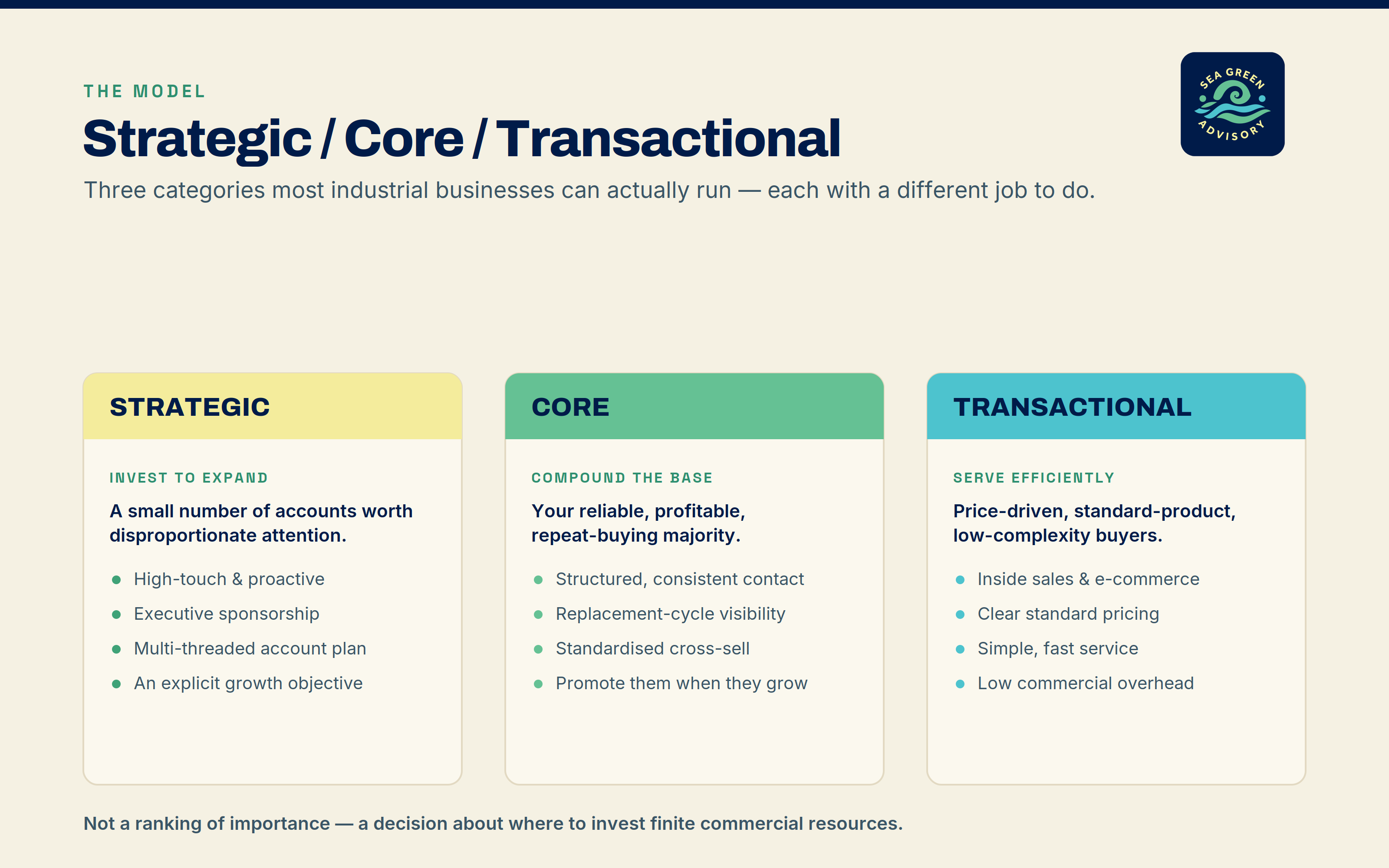
For many industrial businesses, three categories are enough.
A relatively small number of accounts where the potential value of the relationship warrants disproportionate commercial attention.
These may be:
Revenue matters, but revenue alone should not determine strategic status.
A strategic account might currently be relatively small but have enormous potential.
Conversely, a historically large customer may produce substantial revenue but little margin, limited growth and constant commercial friction.
That customer may be important.
It may not be strategic.
These are the customers that create the reliable commercial base of the business.
They fit your offering well.
They purchase regularly.
They are profitable.
They understand your proposition.
They may have opportunities for cross-sell, replacement cycles or modest expansion.
Core accounts generally shouldn't require the same bespoke management as strategic accounts, but they should receive consistent, structured commercial attention.
They are often where a business's most dependable revenue lives.
Ignoring them while chasing the next "big account" can be equally dangerous.
Transactional doesn't mean unimportant.
It means the relationship is primarily transactional.
The customer may:
These customers can still be highly profitable.
The difference is that they generally shouldn't consume strategic-account levels of sales time.
This is where efficient digital communication, inside sales, standardised pricing and simplified service processes become important.
The objective isn't to treat them poorly.
It is to serve them appropriately.
This is where simplistic A/B/C segmentation usually breaks.
If you rank accounts purely according to historical revenue, you're effectively driving while looking through the rear-view mirror.
A better model asks several questions.
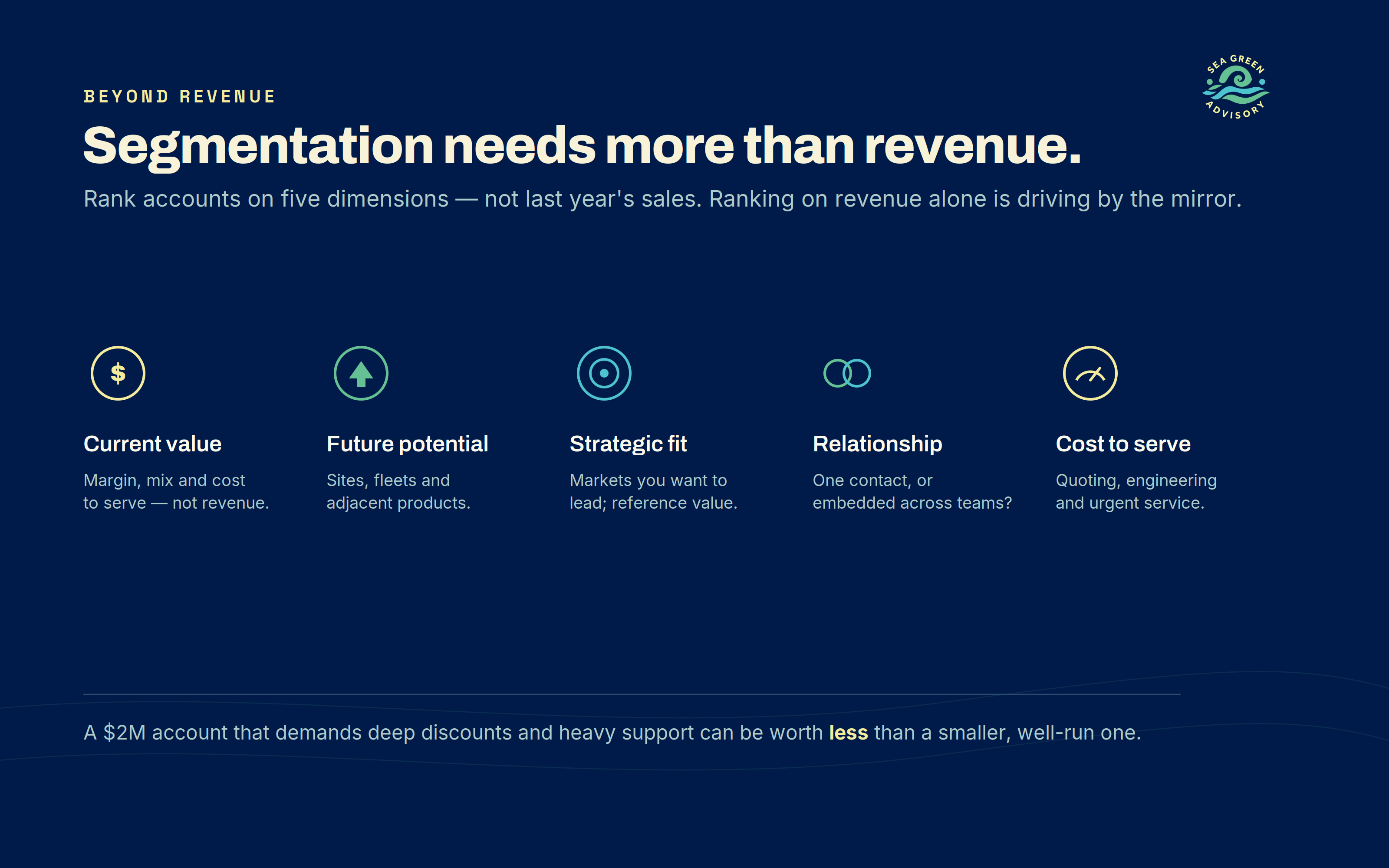
What does the account contribute today?
Look beyond top-line revenue.
Consider:
A $2 million account requiring extraordinary support and aggressive discounts may be less attractive than a smaller, well-managed customer delivering healthier economics.
What could this relationship realistically become?
Consider:
This is particularly important in industrial markets where buying cycles can span years.
Today's $200,000 customer may genuinely be tomorrow's $5 million account.
Does the customer sit within the markets and applications where you want to build leadership?
This matters because some customers provide more than revenue.
They can provide:
A flagship fleet deployment, for example, can influence broader adoption in ways a simple revenue calculation won't capture.
How deeply embedded is the relationship?
Do you have multiple contacts?
Or does the entire account depend on one salesperson knowing one procurement manager?
Strategic relationships should eventually become organisational relationships.
Sales.
Operations.
Service.
Technical.
Leadership.
The deeper the connection, the harder the relationship is for competitors to displace.
This is often ignored.
Some customers consume significant internal resources without generating corresponding commercial return.
Custom engineering.
Repeated quoting.
Special delivery requirements.
Urgent service.
Pricing negotiations.
Constant executive involvement.
Those costs need to be recognised.
A large customer can still be commercially unattractive.
This is where segmentation becomes useful.
The objective isn't creating three boxes on a PowerPoint slide.
The objective is changing behaviour.
Strategic accounts deserve a deliberate growth plan.
Not simply a salesperson "keeping in touch."
There should be a clear view of:
And importantly:
What would materially deepen this relationship over the next 12–24 months?
For strategic accounts, I'd expect:
Leadership should know the customer.
Not because senior executives need to attend every meeting, but because strategically important relationships should extend beyond individual salespeople.
One contact is not an account strategy.
Build relationships across:
Not 40-page documents nobody reads.
A useful account plan can fit on a page:
Current position → Opportunities → Risks → Stakeholders → Next moves.
Every strategic account should have a growth hypothesis.
New sites?
Additional assets?
Different product categories?
Service contracts?
Trials?
Regional expansion?
If the account plan doesn't identify the next commercial horizon, it's a relationship-maintenance plan — not a growth plan.
Core accounts require a different model.
The goal is usually not bespoke strategic management.
It is dependable commercial execution.
That might include:
These customers should feel well looked after without creating an unnecessarily expensive cost-to-serve model.
Core customers are also an excellent source of future strategic accounts.
This is why segmentation shouldn't be static.
A core customer showing increasing volume, broader engagement and multi-site potential should be promoted.
Commercial systems should recognise emerging opportunity early.
This category can be uncomfortable because sales organisations sometimes interpret "transactional" as "low value."
That's the wrong interpretation.
Some transactional customers are very profitable.
What they usually don't justify is a high-touch service model.
This is where organisations need to make better use of:
Salespeople shouldn't spend three hours manually processing something that could take a customer three minutes online.
That's not customer service.
That's poor process design.
And freeing salespeople from that activity allows them to invest time where human interaction genuinely changes the commercial outcome.
This deserves particular emphasis.
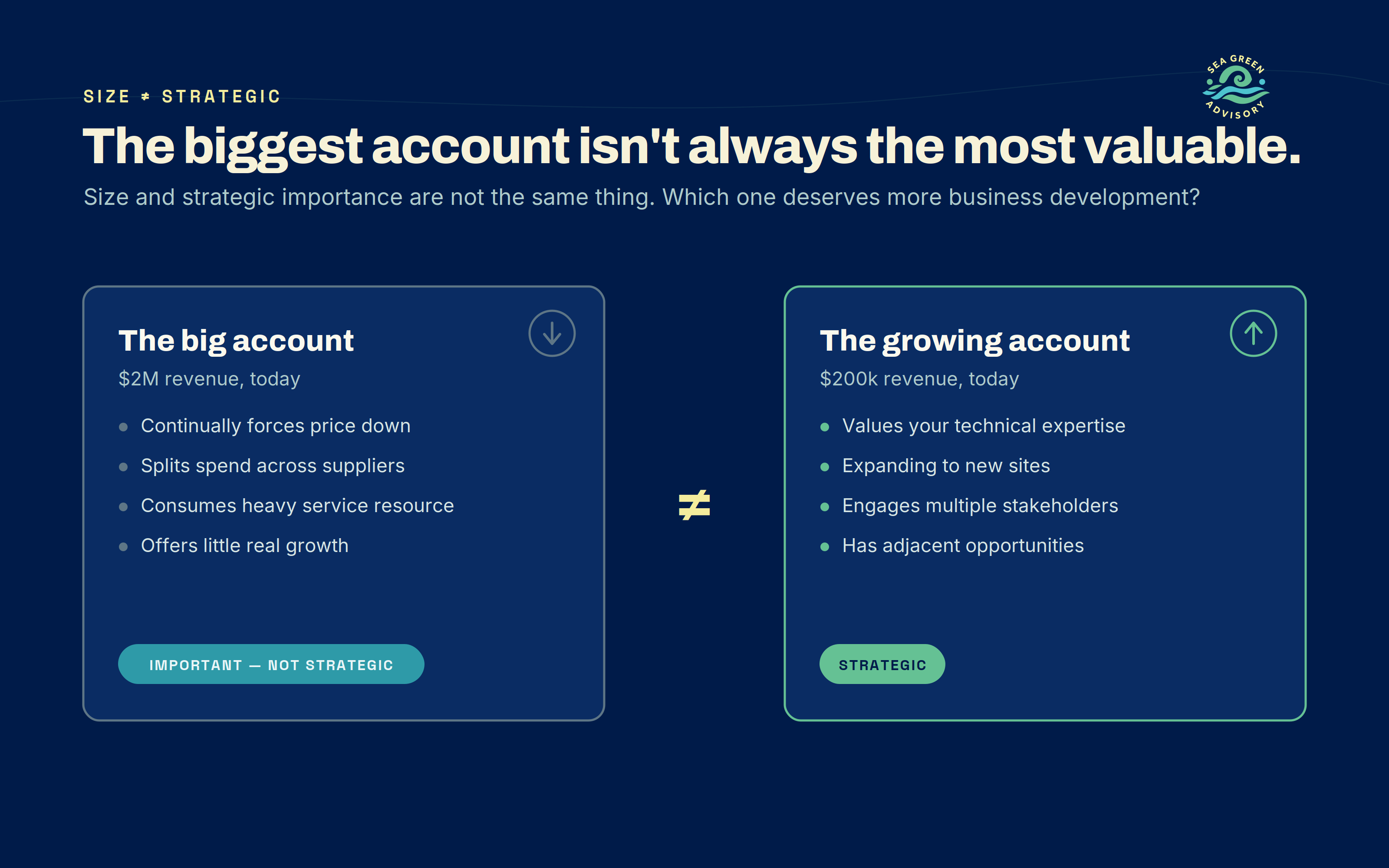
Size and strategic importance are not the same thing.
Imagine a large customer that:
It may still be commercially important.
But automatically categorising it as "strategic" because of revenue can create poor decision-making.
Now compare that with a medium-sized operator that:
Which deserves more business-development attention?
Segmentation should force that discussion.
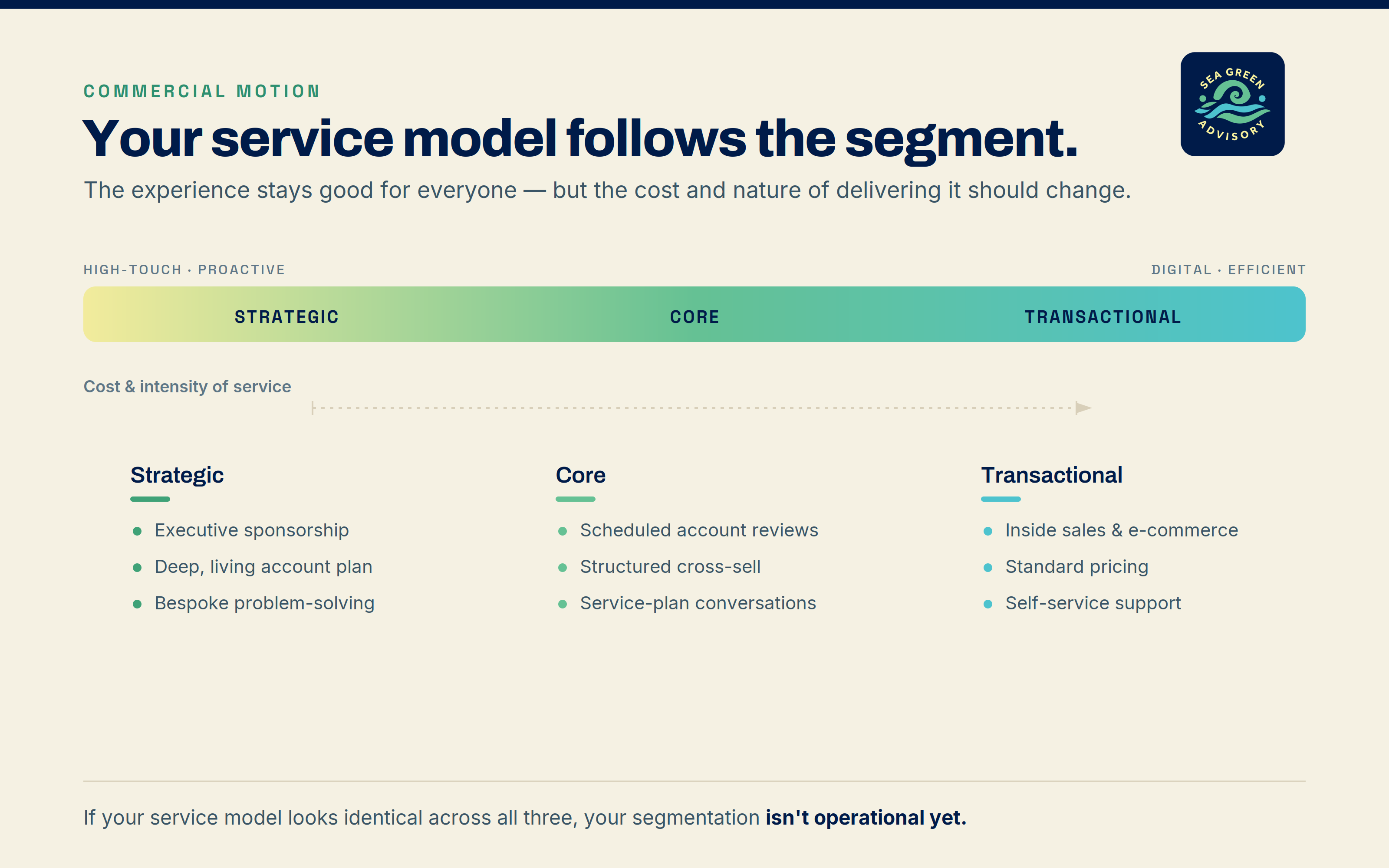
A very simple diagnostic is to place your segment definitions beside your customer-service model.
If everything looks the same, your segmentation isn't operational.
Different categories should produce different expectations.
High-touch, proactive, growth-oriented.
Senior engagement.
Deep account planning.
Bespoke commercial problem-solving when justified.
Structured and consistent.
Regular engagement.
Standardised offers.
Strong service.
Scalable cross-sell.
Efficient and responsive.
Clear pricing.
Simplified transactions.
Lower-cost sales channels.
Excellent basic service without excessive commercial overhead.
The customer experience should still be good across all three.
The cost and nature of delivering it should change.
Account segmentation shouldn't stop at sales.
Marketing should know which customers and prospects matter most.
Strategic accounts may justify:
Core accounts may benefit from:
Transactional audiences may be best served through:
One generic marketing campaign to everyone is usually a sign that segmentation has never moved beyond the spreadsheet.
Strategic doesn't automatically mean "cheapest."
Quite the opposite.
If the relationship delivers additional value — technical support, planning, uptime protection, customised solutions — pricing should recognise that.
Segmentation should help determine:
What it shouldn't do is become an excuse for automatic discounting.
Strategic customers should receive more value, not necessarily lower prices.
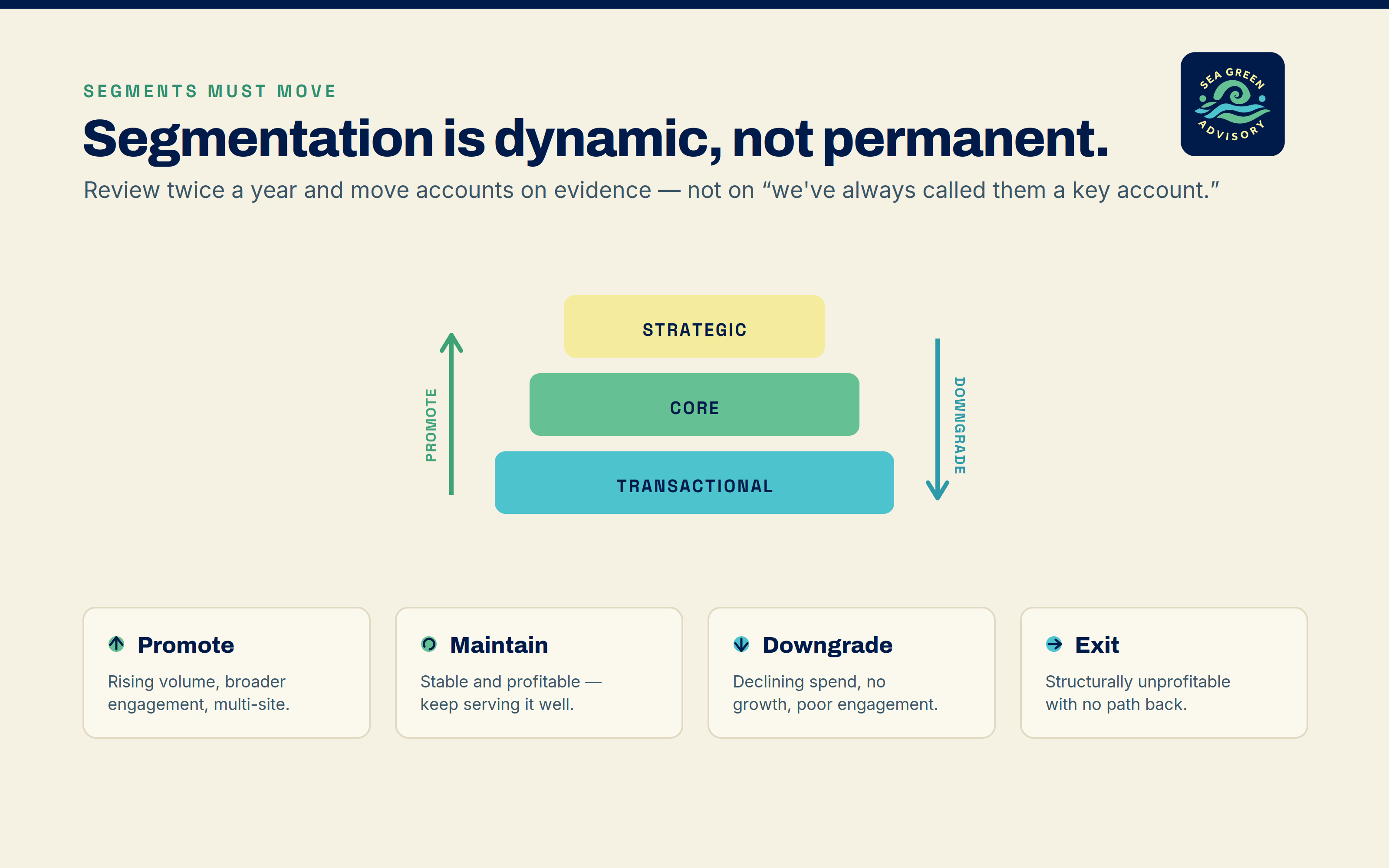
One of the biggest failures in segmentation is allowing categories to become permanent.
"We've always considered them a key account."
That's not a commercial reason.
Customers should move based on evidence.
A transactional customer becoming a fast-growing multi-site operation may move to Core, then Strategic.
A Strategic customer experiencing declining spend, poor engagement and no growth opportunity may need to move back.
That decision can be emotionally difficult — particularly when relationships have existed for years.
But commercial resources need to follow opportunity.
I'd recommend reviewing account segmentation at least twice per year, with clear criteria for:
Promote. Maintain. Downgrade. Exit.
Segmentation should be dynamic because markets are dynamic.
You don't need a major CRM project to start.
Put your top 50 or 100 customers in a room — metaphorically or literally — and assess them against five dimensions:
Then place them into Strategic, Core or Transactional.
The most useful part isn't the final classification.
It's the disagreement.
When Sales says Strategic but Finance says low-margin.
When Service says high-maintenance.
When Marketing sees major reference value.
When leadership sees future expansion.
Those conversations reveal how the organisation actually understands customer value.
Then ask one final question:
What are we going to do differently on Monday because this account sits in this category?
That's where segmentation becomes strategy.
Not all revenue is equal.
Not all customers represent the same opportunity.
And not all relationships deserve the same investment.
The businesses that understand this don't necessarily work harder.
They concentrate effort better.
They protect sales capacity.
They give strategic accounts the attention required to grow.
They systematically develop core customers.
And they serve transactional customers efficiently without compromising the basic customer experience.
That's what good segmentation does.
It transforms customer data into commercial decisions.
Because the objective isn't to label your customers.
The objective is to decide where your organisation can create — and capture — the most value.
Sea Green Advisory works with businesses across commercial vehicles, heavy equipment and industrial markets to create clearer sales, marketing and go-to-market systems.
If your account strategy has become a list of "key customers" rather than a genuine resource-allocation model, we can help build a practical segmentation framework around:
If you'd like to pressure-test whether your sales team is spending enough time on the customers that can genuinely change your business, connect with Sea Green Advisory.
Book a zero obligation chat to see if we’re a good fit for success. We’re ready any time.
Have a chat