The Commercial Clarity System: A Practical Operating Model for Sales + Marketing in Heavy Industry


Smiling man wearing a checked shirt in an industrial or warehouse setting.
Glen Sharman
21/3/2026
10-15 mins

The Commercial Clarity System

  • A practical operating model for Sales + Marketing in heavy industry *

In heavy industry, “growth” often gets treated like a motivational problem.

If we just add more leads, run more campaigns, hire another salesperson, attend another field day, launch another product video… revenue will follow.

But most industrial businesses don’t have an effort problem. They have a clarity problem.

  • Sales is busy, but conversion is inconsistent.
  • Marketing is active, but “leads” don’t turn into opportunities.
  • Dealers want support, but still discount and default to old habits.
  • Forecasts swing wildly because stages mean different things to different people.
  • Everyone agrees the brand needs to “differentiate”, yet the message still sounds like every competitor.

This is what it looks like when your commercial engine runs on activity instead of an operating model.

Sea Green Advisory calls the fix The Commercial Clarity System: a simple, practical structure that turns effort into predictable revenue — without adding noise, headcount, or theatre.

It’s not a CRM setup.
It’s not a marketing plan.
It’s not a sales training program.

It’s the missing link between “we’re doing a lot” and “we’re winning consistently”.

The Commercial Clarity System: a simple, practical structure that turns effort into predictable revenue — without adding noise, headcount, or theatre.

Why heavy industry needs a commercial operating model (not more hustle)

Industrial markets have three realities that punish unclear commercial systems:

1) Buying cycles are long and non-linear

Projects stall, specs change, budgets shift, and deals “go quiet” for reasons outside your control. Without shared definitions, the pipeline becomes a wish list.

2) Channel complexity creates message drift

When dealers and distributors carry your brand, your value proposition gets translated (and often diluted) through multiple layers. If your offer isn’t standardised, the market experiences you inconsistently.

3) Price pressure exposes weak value

If you can’t prove value, you end up negotiating price. And if discounting becomes the default, your best customers train you to erode your own margin.

So the objective isn’t “more activity”.
It’s more clarity: on who you win, what you sell, how you prove it, and how you run weekly execution.
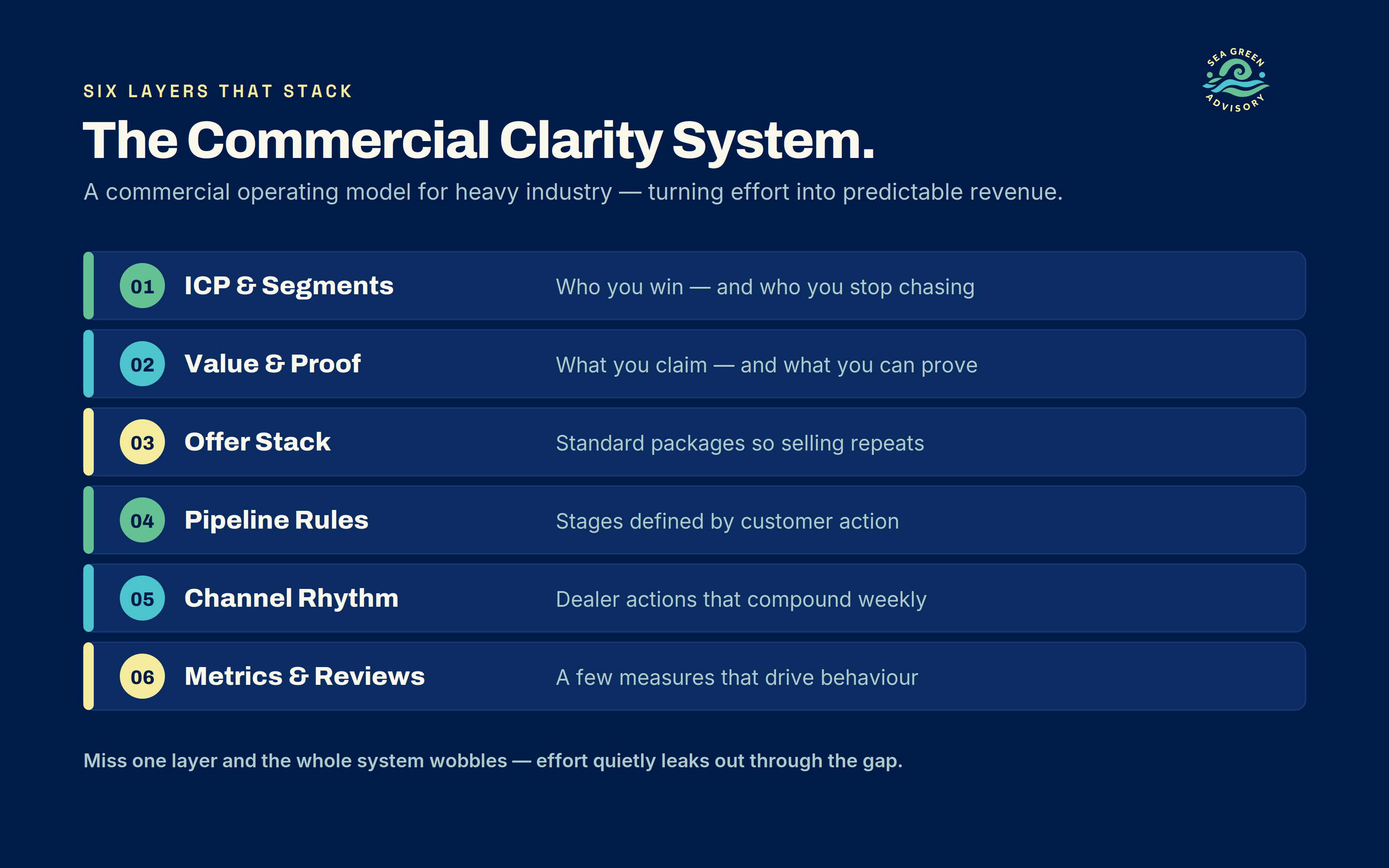
The Commercial Clarity System (6 layers)

Think of this as six layers that stack together. Miss one, and the whole thing wobbles.

Layer 1: ICP & Segments

Who you win — and who you stop chasing.

Most industrial businesses can describe their “target market” broadly (mining, civil, logistics, councils, manufacturing), but that’s not a target. That’s a category.

Clarity means being able to say:

  • Our best-fit customers look like… (fleet size, duty cycle, operating environment, maintenance maturity, safety requirements, procurement style)
  • We win when… (uptime is critical, life-cycle cost is visible, compliance is non-negotiable, service response matters)
  • We lose when… (they only buy on upfront price, decisions are purely tender-driven, the spec is locked to a competitor, service is outsourced and commoditised)

Practical output: a 1-page ICP card and a segmentation model you can actually operate:

  • Strategic (high value, multi-site, complex)
  • Core (repeatable volume, known needs)
  • Transactional (price-led, low leverage)

The goal isn’t to ignore revenue. It’s to stop spending scarce selling time where you can’t win profitably.
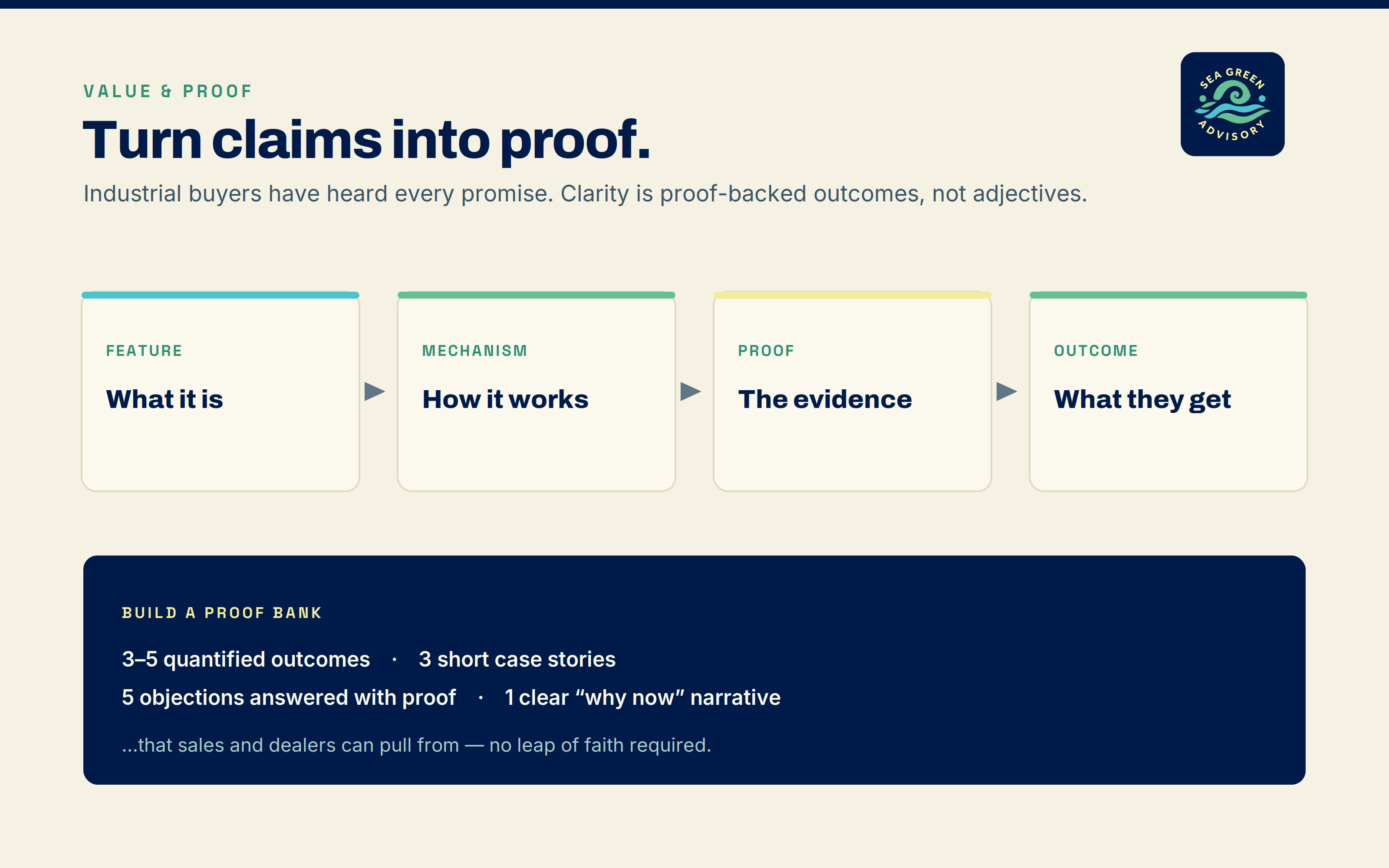
Layer 2: Value & Proof

What you claim — and what you can prove.

Industrial buyers are skeptical (and for good reason). They’ve heard every promise:
“premium quality”, “industry leading”, “best service”, “lower TCO”.

Clarity is turning generic claims into proof-backed outcomes.

A simple structure:

  • Feature: what it is
  • Mechanism: how it works
  • Proof: evidence (data, case result, warranty claim rates, field test, uptime metrics)
  • Outcome: what the customer gets (hours saved, failures prevented, risk reduced, compliance met, cost avoided)

If you can’t show proof, you’re asking the customer to take a leap of faith.

Practical output: a “Proof Bank” that sales and dealers can pull from:

  • 3–5 quantified outcomes
  • 3 short case stories
  • 5 objections with proof-based responses
  • 1 clear “why now” narrative (risk, uptime, safety, compliance, energy volatility)

Layer 3: Offer Stack

Standard packages so selling becomes repeatable.

In heavy industry, customisation feels like service. But it often becomes a trap:

  • quotes take too long
  • proposals are inconsistent
  • discounting happens silently
  • customers compare apples to oranges (and choose the cheapest-looking apple)

A repeatable commercial system uses an offer stack:

  • Good / Better / Best packages (or Base / Performance / Assurance)
  • standard inclusions
  • service response options
  • training / commissioning options
  • commercial terms that protect margin

This doesn’t remove flexibility. It creates a default structure so flexibility is deliberate — not accidental.

Practical output: 3 standard offer packages with:

  • inclusions
  • target segments
  • what to say (positioning)
  • what to show (proof)
  • price architecture (where discounting is allowed vs not allowed)

Layer 4: Pipeline Rules

Stage definitions + qualification gates.

If your pipeline is full but revenue is unpredictable, you probably have a definition problem.

The most common issue: stages are defined by sales activity, not customer commitment.

  • “Quoted” isn’t a stage. It’s a document.
  • “Meeting held” isn’t progress. It’s calendar history.
  • “Proposal sent” isn’t intent. It’s an email.

Clarity means stages are based on verifiable customer actions.

Example qualification gates:

  • Fit confirmed: ICP match, problem is real, urgency is defined
  • Value agreed: outcome and proof align to their priorities
  • Decision process mapped: stakeholders, timeline, procurement path
  • Commercial range validated: budget or range confirmed (not guessed)
  • Next step scheduled: mutual plan, not “follow up next week”

Practical output: a one-page stage definition guide that every seller and dealer can apply the same way — so forecast becomes something you can trust.

Layer 5: Channel Rhythm

Dealer actions that compound weekly.

In dealer and distributor environments, performance doesn’t lift with one big initiative. It lifts with a weekly rhythm that:

  • focuses attention
  • drives follow-up
  • reduces “invisible discounting”
  • improves product mix
  • and turns marketing from “content” into conversion support

A simple rhythm:

  • weekly pipeline review (30 minutes)
  • top 10 priority accounts
  • top 10 active opportunities with next step dates
  • quote ageing review
  • lost deals review (what actually happened?)
  • one enablement topic (proof, objection handling, offer stack refresh)

Practical output: a dealer execution cadence that is light, consistent, and measurable — not a quarterly “big push” that fades.

Layer 6: Metrics & Reviews

Few measures that drive behaviour.

Most industrial teams track too much and learn too little.

Clarity is choosing a small set of metrics that connect to outcomes:

  • conversion rate by segment
  • quote-to-order rate
  • average discount by offer package
  • stage velocity (time in stage)
  • win/loss reasons (real reasons, not “price”)
  • activity that matters (calls to ICP accounts, not total calls)

And then reviewing them in a way that produces action — not blame.

Think of this as six layers that stack together. Miss one, and the whole thing wobbles.

Practical output: a monthly commercial review pack that aligns Sales + Marketing + Channel around what’s working, what’s not, and what changes next.
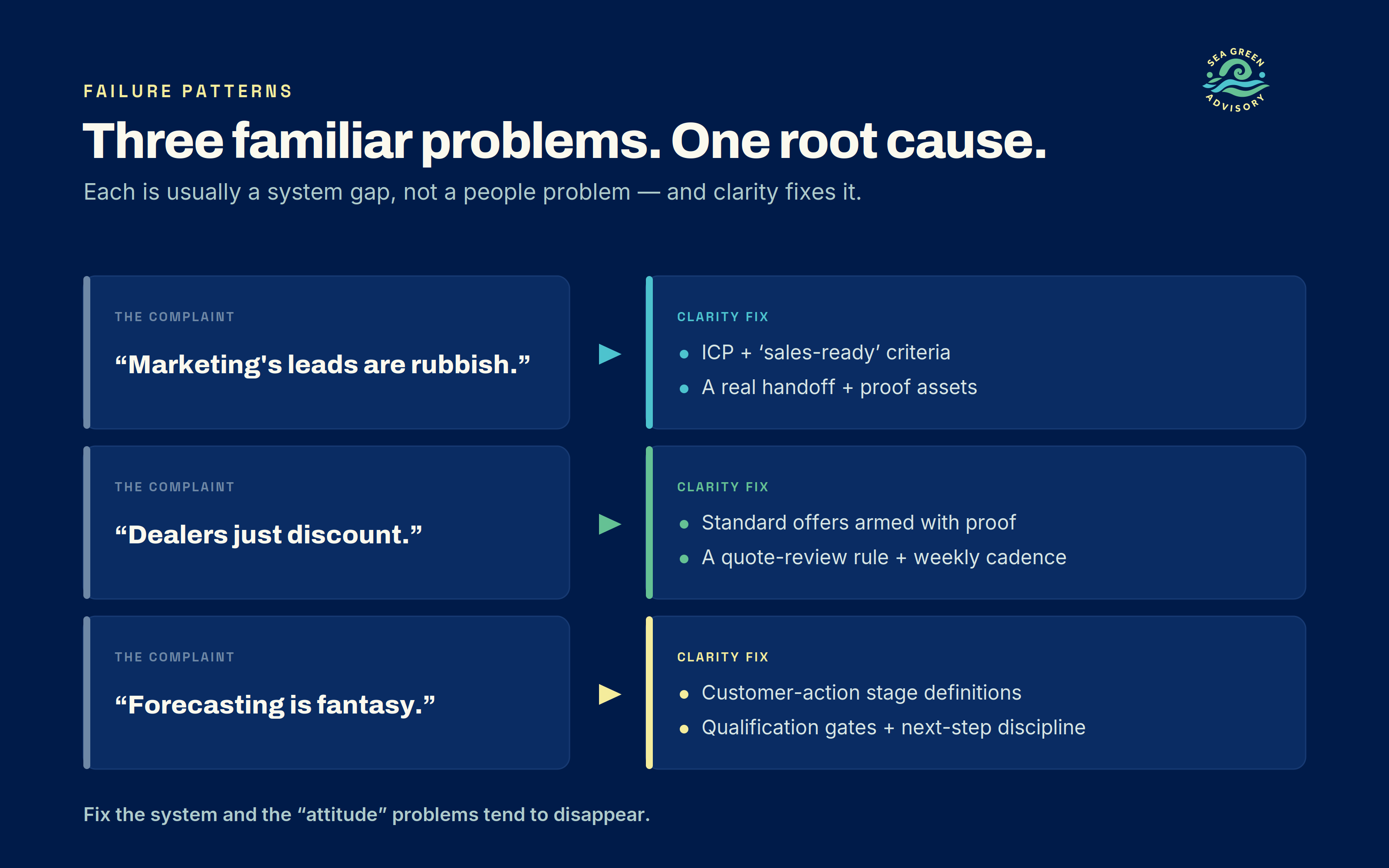
Three common failure patterns (and how clarity fixes them)

Pattern 1: “Marketing is generating leads, but sales says they’re rubbish.”

Usually true. Also usually fixable.

Clarity fix:

  • define ICP and segment rules
  • define “sales-ready” criteria (not “downloaded a brochure”)
  • build a handoff process: what information must exist before it becomes an opportunity
  • build proof assets that help qualification (not just awareness)

Pattern 2: “Dealers won’t sell the value — they just discount.”

Discounting isn’t a dealer attitude problem. It’s often a system gap.

Clarity fix:

  • standardise offer packages
  • arm dealers with proof (not slogans)
  • implement a simple quote review rule for large discounts
  • reinforce weekly cadence so deals don’t drift into price-only conversations

Pattern 3: “Forecasting is fantasy.”

It’s not because your people are dishonest. It’s because stages mean different things.

Clarity fix:

  • customer-action stage definitions
  • qualification gates
  • consistent next-step scheduling
  • pipeline hygiene rules (ageing, re-qualification)

Implementation: the 30-day Commercial Clarity sprint

This system doesn’t require a massive transformation program. It works best as a tight sprint.

Week 1: Define who you win

  • ICP card
  • segments (Strategic / Core / Transactional)
  • stop-doing list (where you stop spending time)

Week 2: Build the proof bank

  • top outcomes
  • quantified evidence
  • objection responses
  • 3 short case stories

Week 3: Standardise offers + pipeline rules

  • offer stack (3 packages)
  • stage definitions and gates
  • quoting rules (when to quote, when to walk)

Week 4: Install the rhythm

  • dealer cadence
  • review pack metrics
  • enablement plan (what gets reinforced weekly)

The aim: move from “busy” to “consistent”.

The bottom line

Most industrial businesses don’t need more marketing noise or more sales hustle.

They need a commercial operating model that makes winning repeatable.

The Commercial Clarity System gives you:

  • focus (who you win)
  • confidence (proof)
  • consistency (offers and stages)
  • and execution (channel rhythm + metrics)

That’s how you protect margin, lift conversion, and build predictable growth — in markets where trust and uptime matter more than hype.

If you want help implementing the Commercial Clarity System inside your business — across direct sales, dealer/distributor networks, and marketing — Sea Green Advisory can run a Commercial Clarity Sprint to deliver:

  • ICP & segmentation model
  • proof bank + messaging structure
  • standard offer stack
  • pipeline stage definitions + qualification gates
  • dealer execution rhythm + review pack

Reach out via Sea Green Advisory to discuss a sprint and what “clarity” would unlock in your market.

Share this post
Smiling man wearing a checked shirt in an industrial or warehouse setting.
Glen Sharman
Founder of Sea Green Advisory
Back to Blog Library

Heading 1

Heading 2

Heading 3

Heading 4

Heading 5
Heading 6

Lorem ipsum dolor sit amet, consectetur adipiscing elit, sed do eiusmod tempor incididunt ut labore et dolore magna aliqua. Ut enim ad minim veniam, quis nostrud exercitation ullamco laboris nisi ut aliquip ex ea commodo consequat. Duis aute irure dolor in reprehenderit in voluptate velit esse cillum dolore eu fugiat nulla pariatur.

Block quote

Ordered list

  1. Item 1
  2. Item 2
  3. Item 3

Unordered list

  • Item A
  • Item B
  • Item C

Text link

Bold text

Emphasis

Superscript

Subscript

Ready to chat strategy?

Book a zero obligation chat to see if we’re a good fit for success. We’re ready any time.

Have a chat

White semi truck driving on a highway at sunset with blurred motion and colorful sky.