Go-to-Market for New Product Launches in Industrial Sectors (Without the Hype) New product launches in industrial and heavy sectors rarely fail because of design, quality or engineering.
They fail because of go-to-market reality .
The product is “launched” but not truly sold Dealers don’t prioritise it Sales teams revert to legacy products - scared of the unknown Pricing is unclear or inconsistent Marketing creates noise, not demand Pipeline fills with curiosity, not conversion Six months later, the post-mortem sounds familiar: “Great product… wrong timing… market not ready…”
In most cases, the issue isn’t timing or readiness. It’s this:
The launch was treated as an event—not as an execution system.
This article outlines a practical, field-tested approach to launching industrial products without hype, without theatre, and without relying on hope.
The core problem: launches are built for attention, not adoption Most launches optimise for visibility:
POS Items (e.g brochures) Launch events Internal presentations Dealer announcements But visibility DOES NOT equal traction.
In industrial markets, adoption depends on:
Sales confidence Dealer prioritisation Application clarity Pricing structure Proof of performance Pipeline discipline If those aren’t in place, the launch fades—no matter how strong the product is.
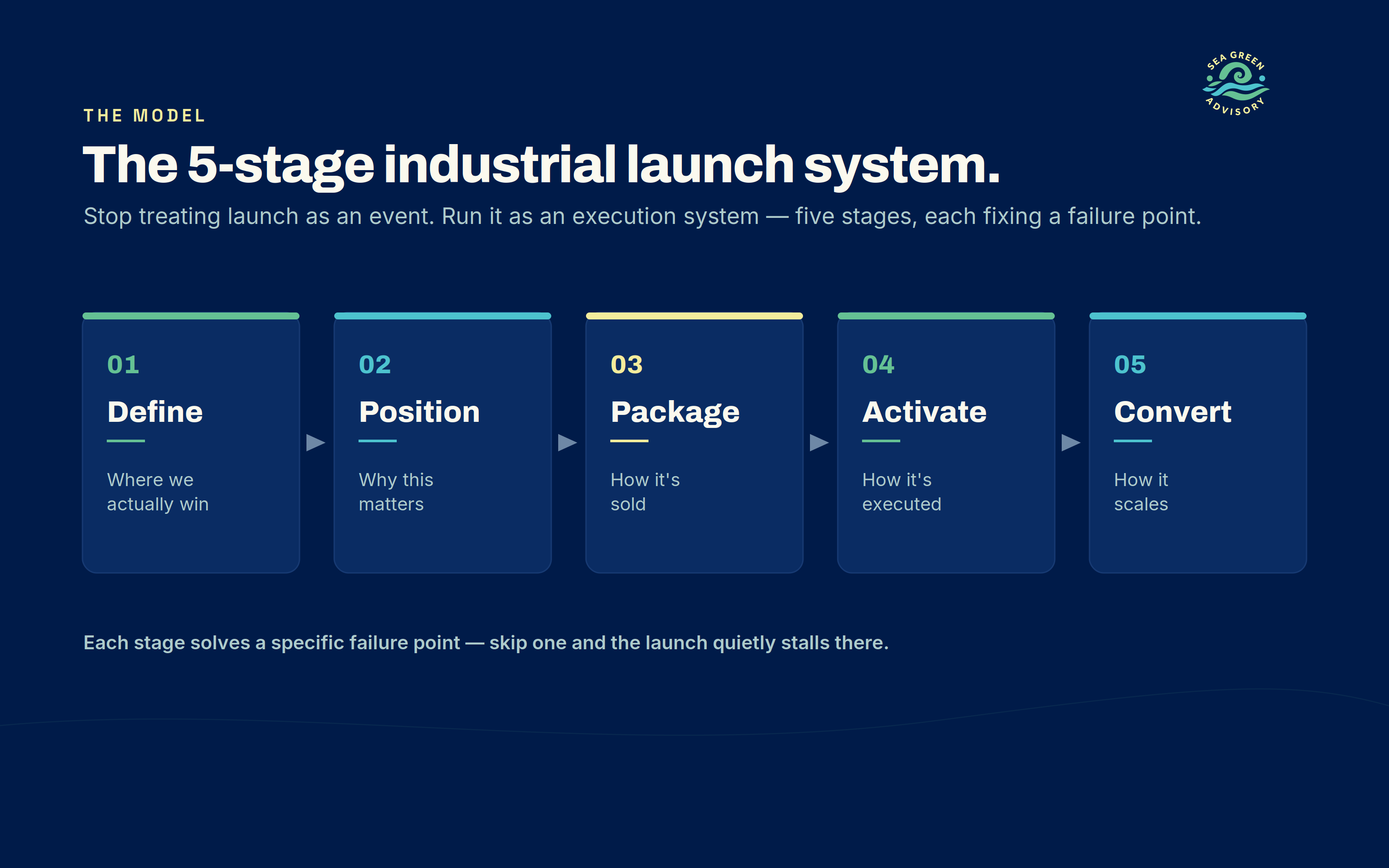
A better model: The 5-stage Industrial Launch System Instead of thinking in terms of “launch date,” think in terms of five execution stages :
Define (where we win) Position (why this matters) Package (how it’s sold) Activate (how it’s executed) Convert (how it scales) Each stage solves a specific failure point.
Stage 1: Define (where we actually win) Most launches start too broad:
“This product is for multiple industries…”
That’s a fast path to weak traction.
Focus is the multiplier Before anything else, define:
2–3 priority segments Specific applications Clear “why now” triggers Practical questions Where does this product outperform alternatives—clearly? Which customers feel the problem most acutely? Where is switching friction low enough to win? Output A tight ICP (ideal customer profile) A short list of target accounts or segments A clear “do not chase” list If you skip this, the market defines your positioning for you—and usually poorly.
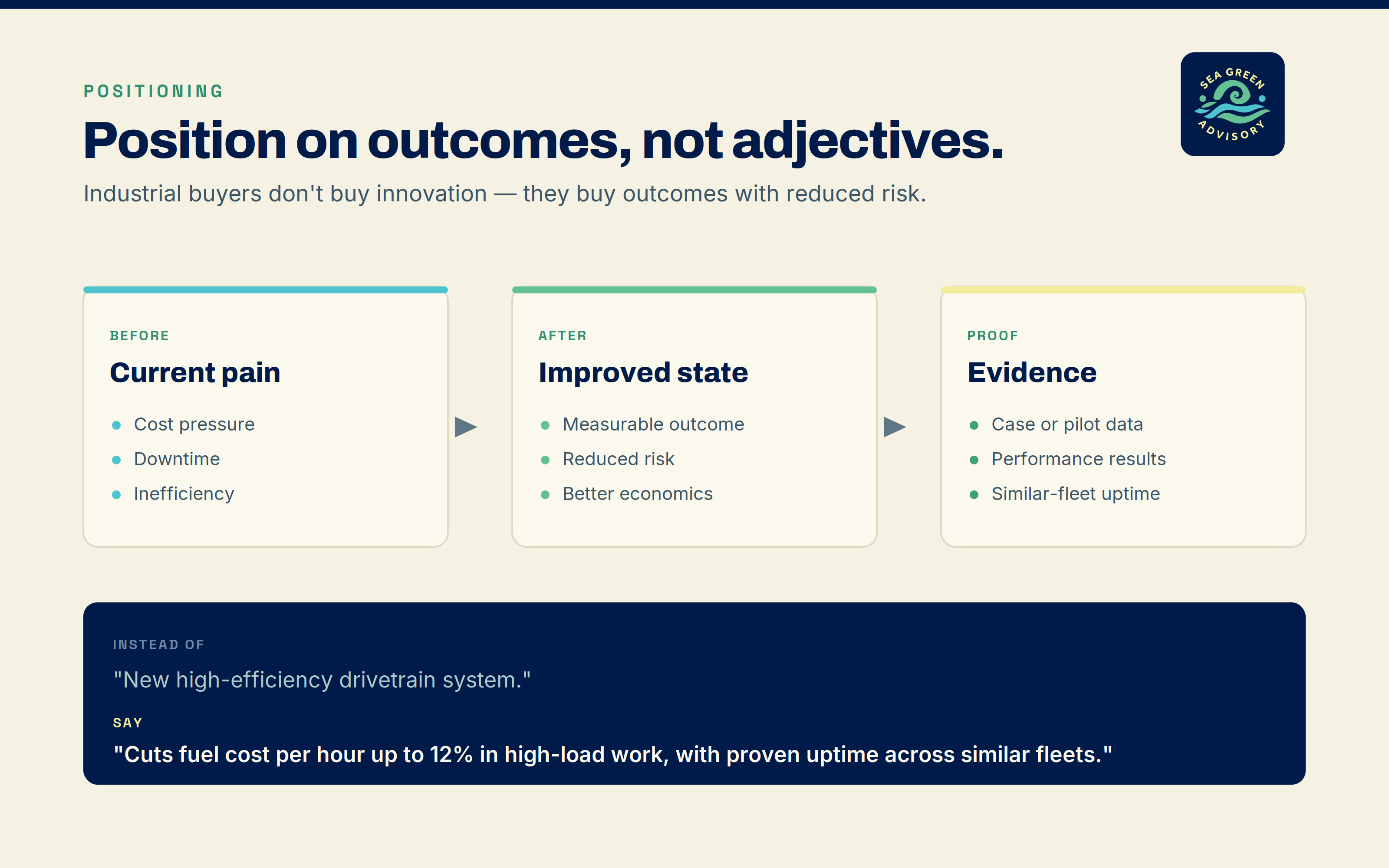
Stage 2: Position (why this product matters) Industrial buyers don’t buy innovation.outcomes with reduced risk .
If your positioning sounds like:
“Next Generation” “Innovative Design” “Enhanced Features” …it will be ignored.
Strong positioning answers three questions: What problem does this solve? Why is it better than current alternatives? Why should the customer act now? Practical structure Before: current state pain (cost, downtime, inefficiency)After: improved state (measurable outcomes)Proof: evidence that this worksExample (simplified) Instead of:
“New high-efficiency drivetrain system”
Say:
“Reduces fuel cost per hour by up to 12% in high-load applications, with proven uptime performance across similar fleets.”
Positioning must be:
Specific Outcome-led Backed by proof
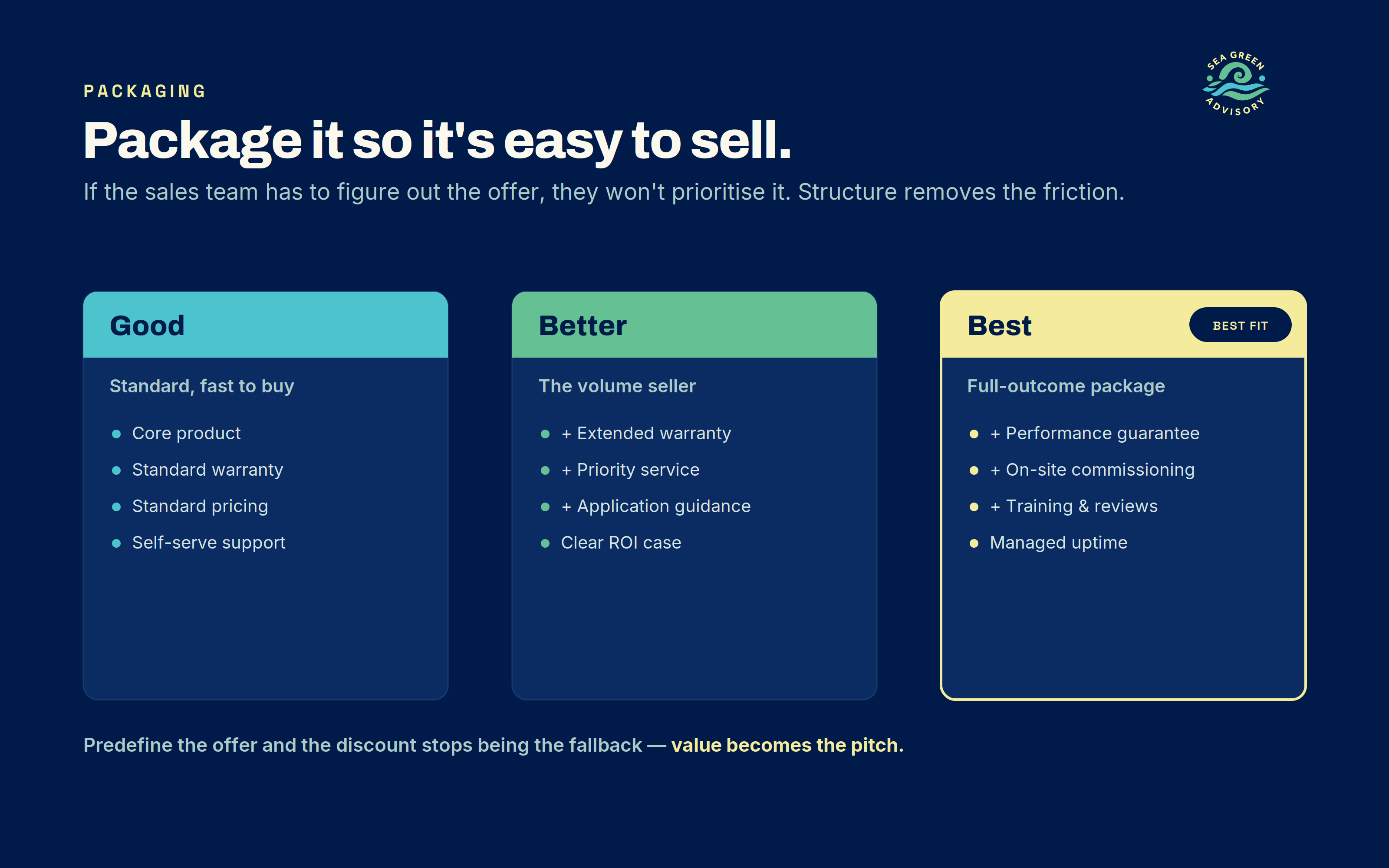
Stage 3: Package (make it easy to sell and buy) A common failure point: the product is ready—but the offer isn’t .
If the sales team has to “figure it out,” they won’t prioritise it.
The role of packaging Packaging removes friction:
For the customer (clear decision) For the sales team (clear offer) Practical approach: structured offers Build:
Good / Better / Best configurations Predefined inclusions (service, warranty, support) Optional add-ons with clear boundaries Include: Pricing guidance (not just list price) Application fit Expected ROI or performance improvement Proof points (case, pilot, test data) What this avoids Endless custom quotes Inconsistent pricing Hesitation from sales teams Slow decision cycles If packaging is weak, discounting becomes the fallback.
Stage 4: Activate (what actually happens in the field) This is where most launches break.
The product exists. The materials exist.
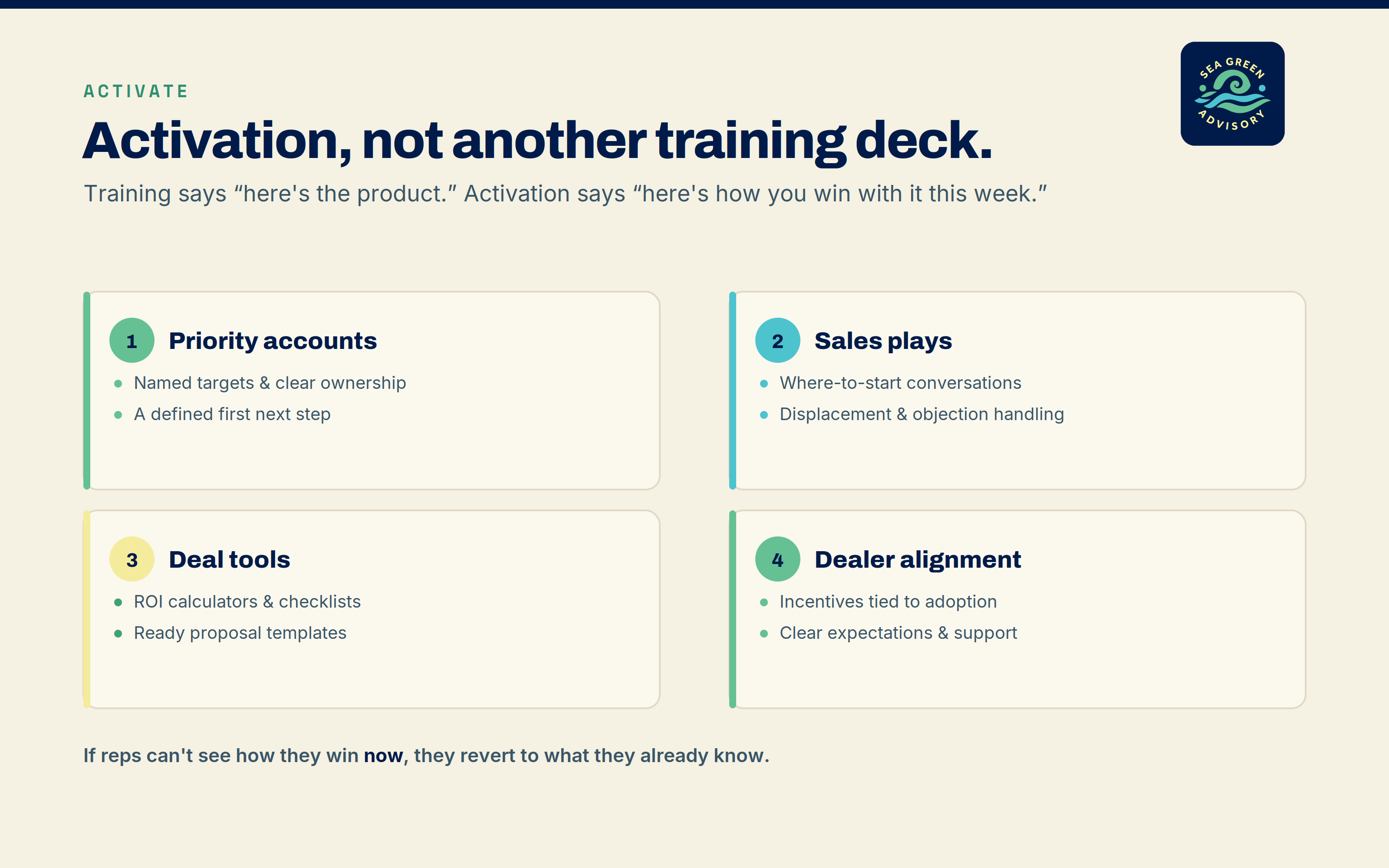
Activation is not training Training says: “Here’s the product.”
What activation must include 1. Priority account targeting Named accounts Clear ownership Defined next steps 2. Sales plays “Where to start” conversations Competitor displacement angles Objection handling 3. Deal tools ROI calculators Application checklists Proposal templates 4. Dealer alignment Incentives tied to adoption Clear expectations Support structure If dealers or reps don’t see how this helps them win immediately , they revert to what they know.
Stage 5: Convert (turn interest into revenue) Early-stage pipeline often looks healthy:
But conversion is where reality hits.
Common breakdowns Unclear qualification Stalled deals Weak follow-up Price pressure No urgency Conversion requires structure Define clear stage gates Problem validated Application confirmed Stakeholders aligned Economic case understood Proposal reviewed live Run deal reviews Focus on next action , not “status” Challenge weak deals early Prioritise real opportunities Protect pricing Apply give-get discipline Avoid early discounting Reinforce value and outcomes Launch success is not measured by pipeline created.pipeline converted.
The hidden lever: internal confidence One of the most overlooked factors in product launches:
Do your sales teams actually believe in the product?
If not, you’ll see:
Hesitation Over-discounting Fallback to legacy products Build confidence through: Real customer proof (even small wins) Pilot programs Internal success stories Field support during early deals Confidence is built through experience, not presentations .
Common launch mistakes (and how to avoid them) Mistake 1: Launching too broadly Fix: Start narrow, win, then expand.
Mistake 2: Over-indexing on marketing Fix: Align sales execution first, then amplify.
Mistake 3: No clear offer structure Fix: Package before you promote.
Mistake 4: Weak dealer engagement Fix: Tie incentives and support to adoption.
Mistake 5: No execution rhythm Fix: Weekly cadence with real deals and actions.
What success actually looks like A strong industrial product launch doesn’t look flashy.
It looks like:
Consistent messaging in the field Targeted account activity Structured offers being used Deals progressing stages Pricing holding within guardrails Repeatable wins across regions It feels controlled, not chaotic .
A simple launch checklist (practical starting point) Before launch:
Define 2–3 priority segments Build outcome-led positioning Create structured offers Prepare deal tools During launch:
Assign priority accounts run weekly deal reviews support early deals closely After launch:
refine positioning based on reality capture proof scale what works