Some of your biggest accounts quietly lose you money. Here's a practical way to see the true cost to serve — and act on it.



Every business has an account like this.
It sits near the top of the revenue report. Everyone knows the name. When someone asks "how's business?", it's one of the first customers mentioned. Losing it would feel like a genuine blow.
And yet — if you followed that account around for a month, tallying every requote, every "quick favour" from engineering, every expedited freight run, every priority service call-out, every hour spent chasing a late payment — you might find something uncomfortable.
It isn't really making you much money at all.
Not because the price was wrong on paper. The gross margin might even look healthy. But somewhere between the quote and the bank, the profit quietly leaked out — through all the work it takes to keep that customer happy that nobody ever priced, tracked, or questioned.
That's cost to serve. And in heavy industry, it's one of the biggest blind spots in the whole commercial system.
Here's the core of the problem.
Revenue is easy to see. It's on every dashboard, every report, every league table. The big accounts get celebrated precisely because the number at the top is big.
Cost to serve is the opposite. It's scattered across other people's budgets — engineering hours, service call-outs, freight, credit control, admin — and it almost never gets traced back to the specific customer that caused it.
So we manage half the equation. We optimise the visible half (revenue) and stay blind to the half that quietly decides whether the account is actually worth having.
Which leads to a reframe worth sitting with:
On your most demanding accounts, you may not have a pricing problem or a discount problem. You have a cost-to-serve problem you can't see.
And you can't fix — or price for — what you can't see.
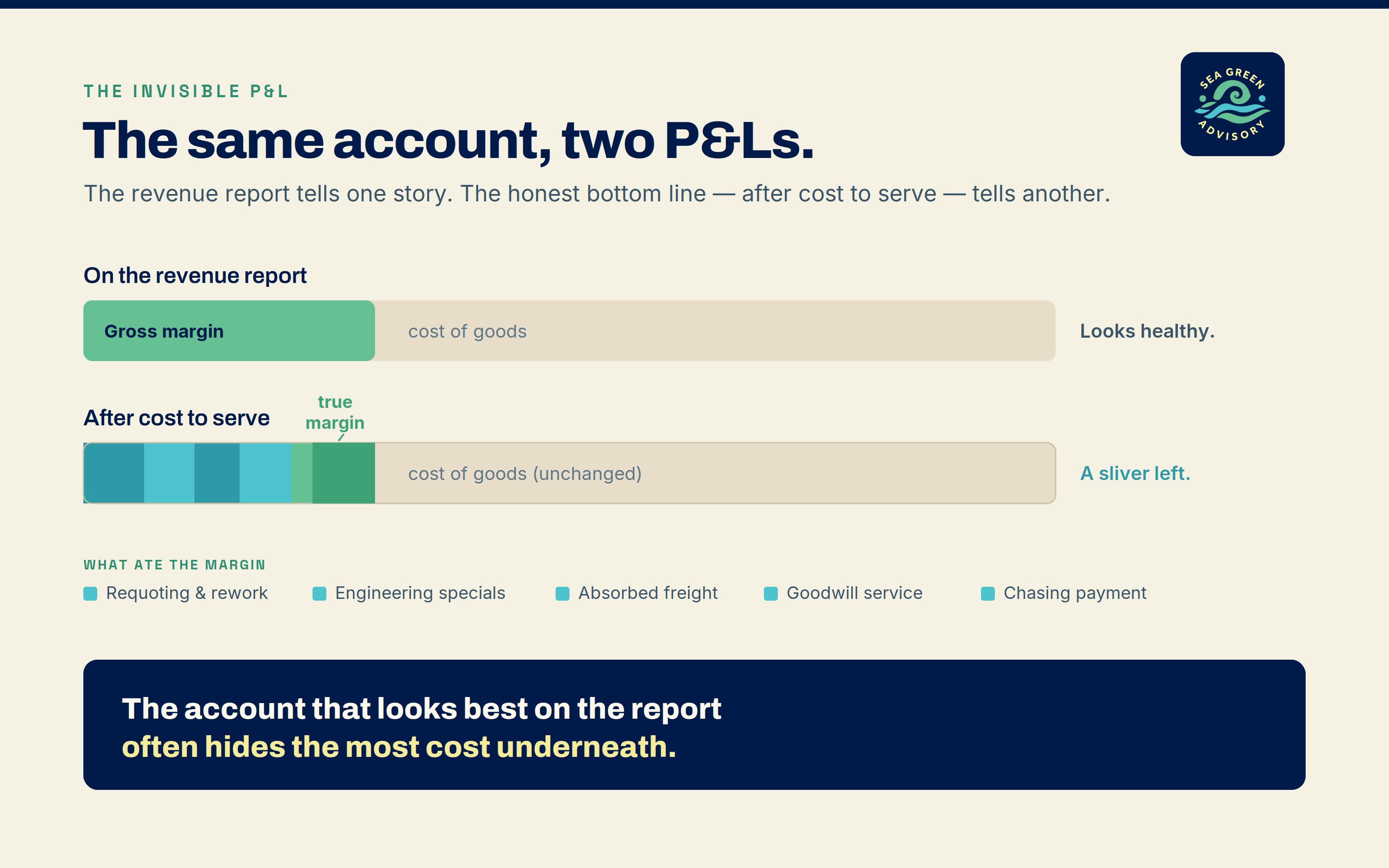
Take that big account and imagine its real profit-and-loss statement — not the one the report shows, but the honest one.
The revenue looks great. The gross margin, on paper, looks fine.
Then reality starts eating in. The three rounds of requoting before the order. The special bracket engineering redesigned "just this once" (for the fourth time). The freight you absorbed to stay competitive. The two after-hours call-outs that were really goodwill. The 68-day payment terms and the phone calls it took to collect.
None of it appeared on the quote. All of it came out of your margin.
By the time you reach the bottom line, that "healthy" account can be delivering a fraction of the profit its revenue implied — sometimes less than a smaller, quieter customer who simply buys, pays, and gets on with it.
That's the uncomfortable truth about cost to serve: the account that looks best on the revenue report is often the one hiding the most cost underneath.
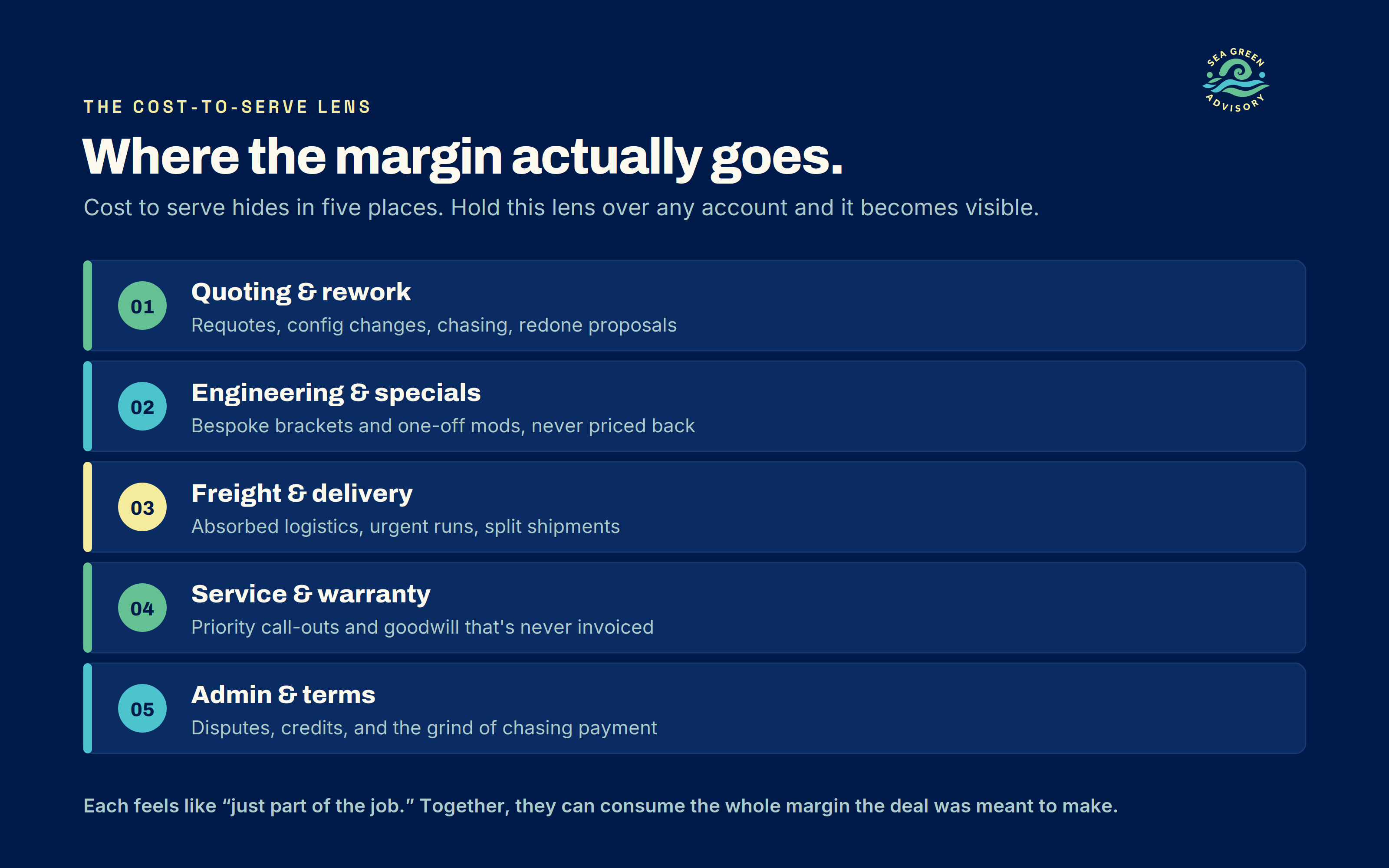
So where does it actually go? In my experience, cost to serve hides in five places. Think of them as a lens you can hold over any account.
1. Quoting & rework. Endless requotes, constant configuration changes, chasing information, redoing proposals. Some customers consume ten times the pre-sale effort of others — for the same order.
2. Engineering & specials. Bespoke brackets, custom configurations, one-off modifications — real technical work that rarely gets priced back into the deal.
3. Freight & delivery. Absorbed logistics, urgent runs, split shipments, redeliveries because the site wasn't ready.
4. Service & warranty. Priority call-outs, generous goodwill, hand-holding, and the "can you just send someone?" that never gets invoiced.
5. Admin & terms. Complex ordering, disputes, credits, and the slow grind of chasing payment on extended terms.
Individually, each feels like just part of the job. Added up — across a year, for a demanding account — they can quietly consume the entire margin the deal was supposed to make.
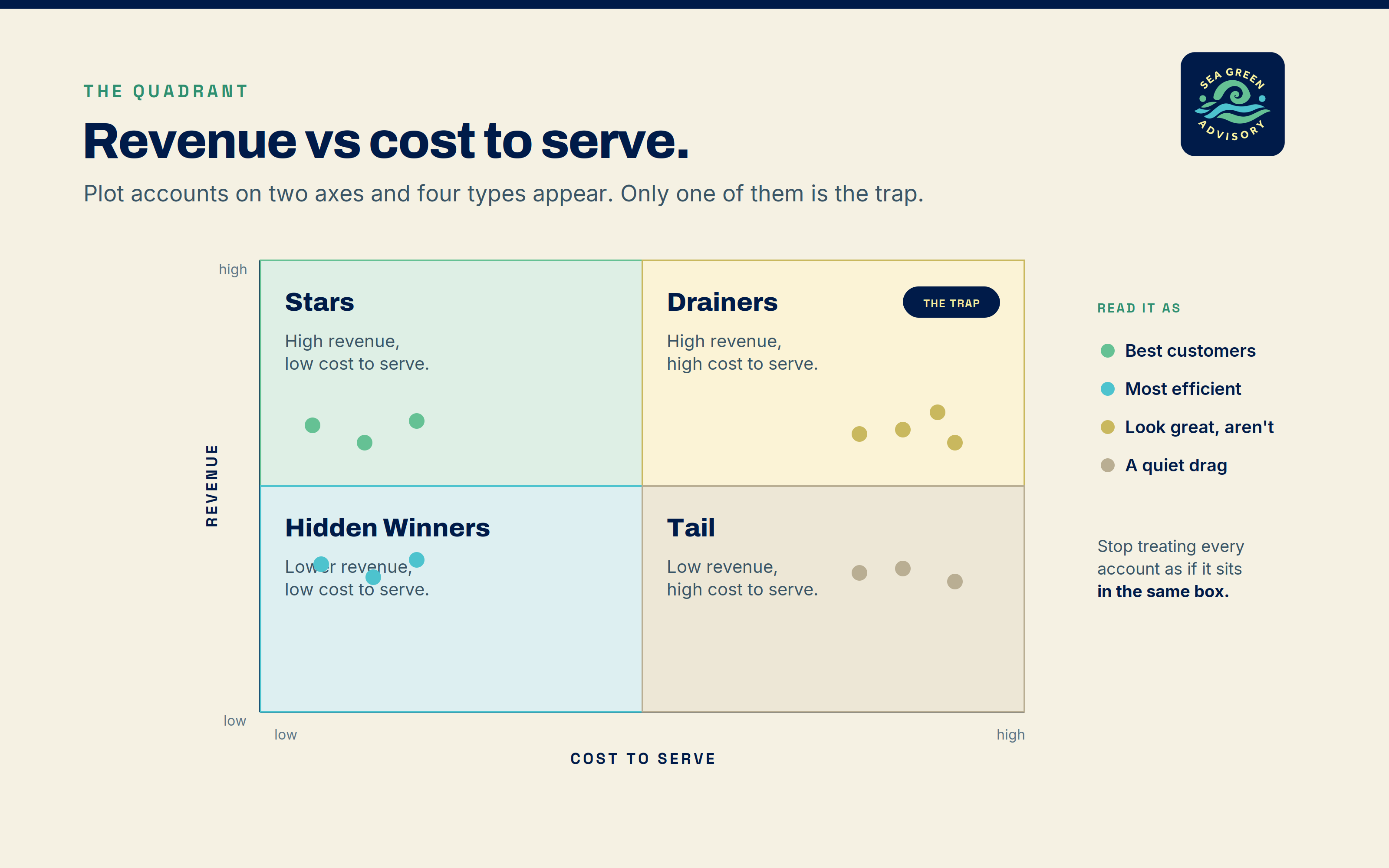
Once you can see cost to serve, a simple picture emerges. Plot your accounts on two axes — revenue up the side, cost to serve across the bottom — and four types appear.
Stars — high revenue, low cost to serve. Your best customers, full stop. Big, and easy to do business with. Protect them fiercely, understand exactly why they're so easy to serve — then go looking for more like them.
Hidden Winners — lower revenue, low cost to serve. Quiet, profitable, undemanding. They rarely get attention because the revenue number is modest — but per dollar of effort, they're often your most profitable accounts. This is where growth frequently hides.
Drainers — high revenue, high cost to serve. The trap. Big enough to feel important, demanding enough to erode the margin. These are the accounts that feel like your best customers and quietly aren't — and they need the most deliberate attention.
Tail — low revenue, high cost to serve. Small and demanding. Individually minor, collectively a real drag — on the business, and on the time of the people serving them.
The goal isn't to label customers "good" and "bad." It's to stop treating every account as if it sits in the same box — and to serve, price and prioritise according to where it actually sits.
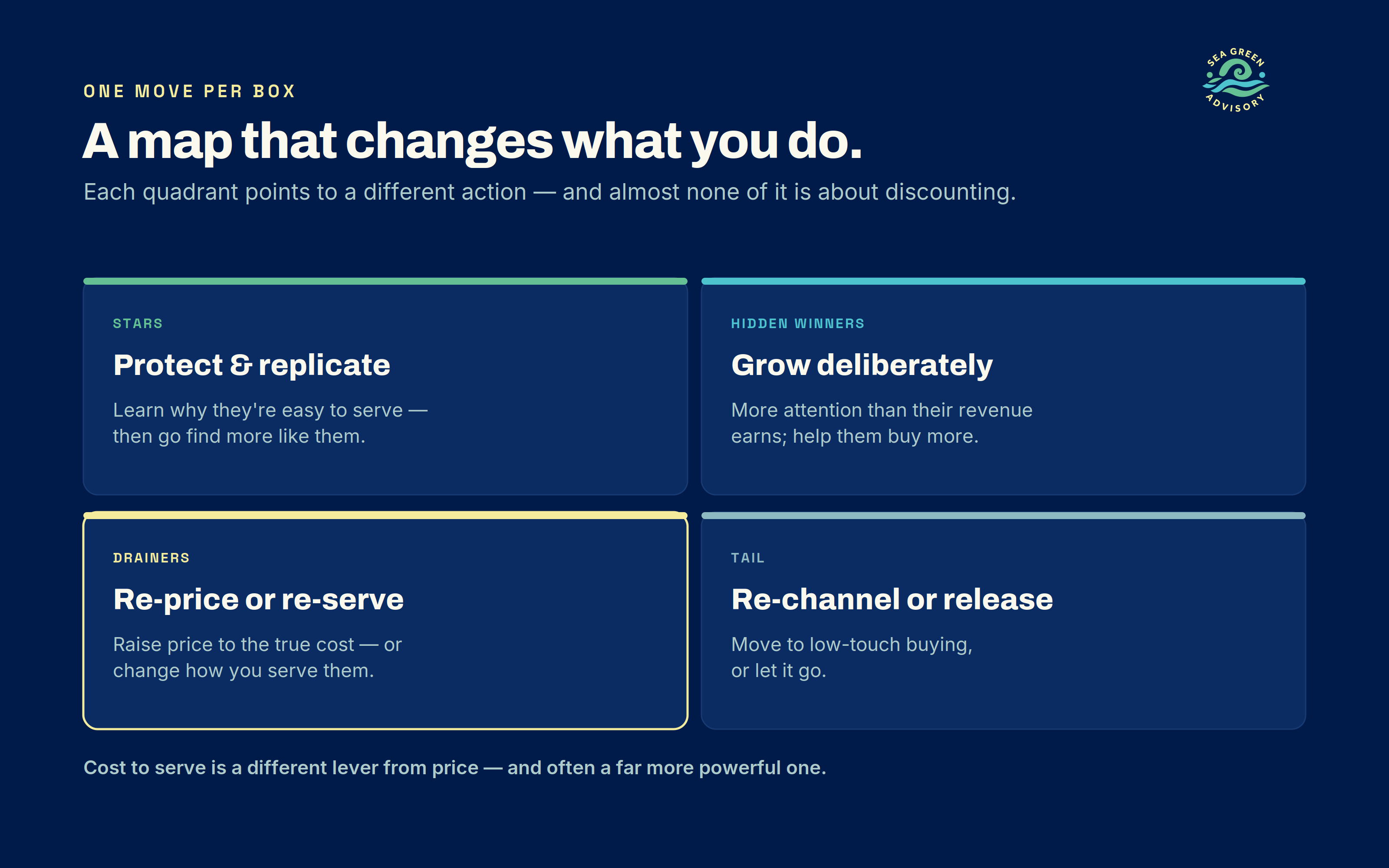
A map is only useful if it changes what you do. Each quadrant points to a different move.
Stars → protect & replicate. Don't get complacent. Understand what makes them low cost to serve, and go find lookalikes.
Hidden Winners → grow deliberately. Give them more attention than their revenue currently earns. They're efficient to serve — help them buy more.
Drainers → re-price or re-serve. This is the highest-value work in the whole exercise. Either the price rises to match the true cost of serving them, or the way you serve them changes — tighter processes, standardised configurations, agreed service levels. Often the honest conversation — "here's what this level of support actually involves" — resets the relationship somewhere healthier.
Tail → re-channel or release. Move them to a simpler, lower-touch way of buying — inside sales, standard products, self-service, or a distributor. And where an account is structurally unprofitable with no path to change, it's okay to let it go.
Notice how little of this is about discounting. Cost to serve is a different lever entirely — and often a far more powerful one.
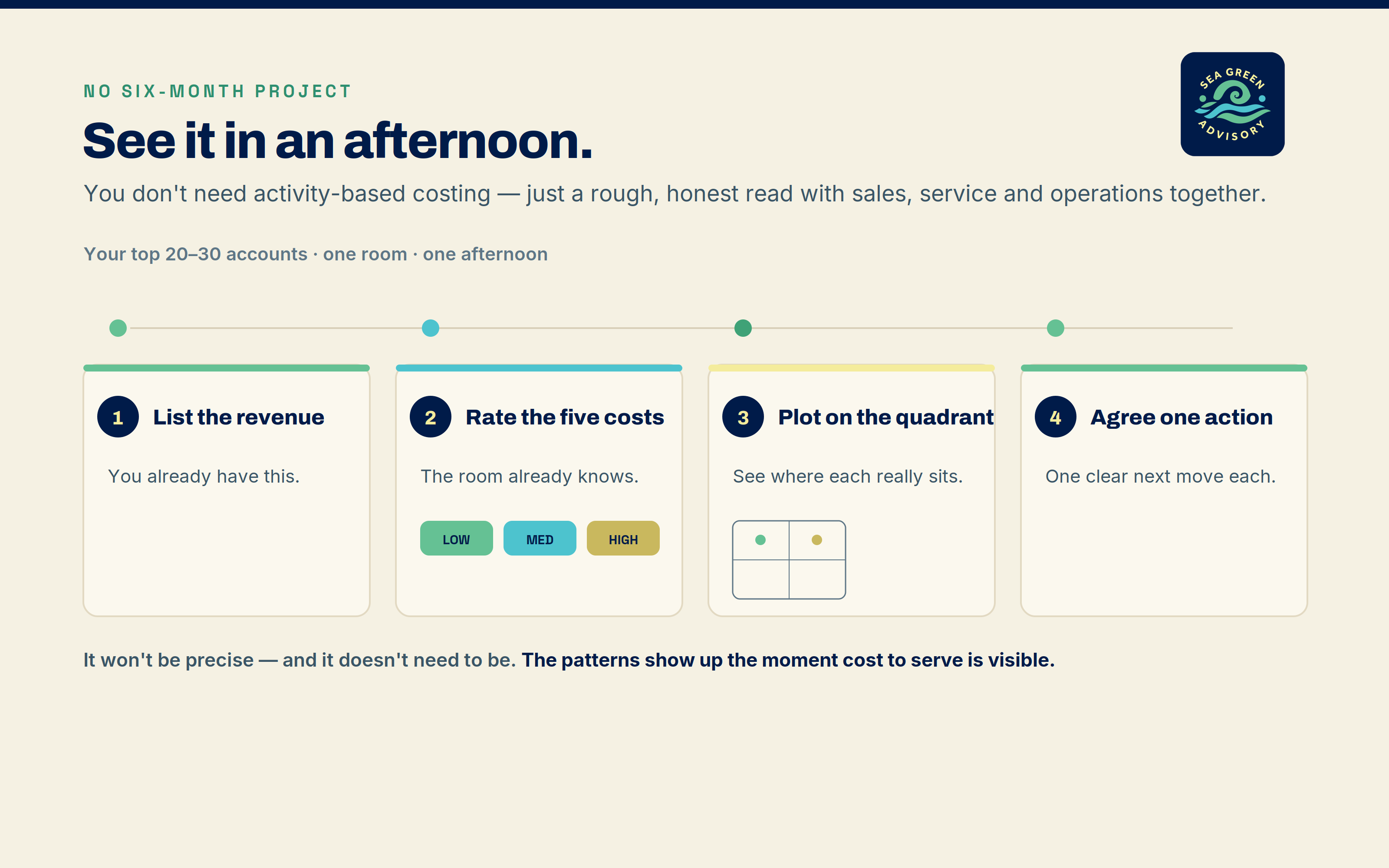
You don't need a perfect activity-based costing model to get value from this. You need a rough, honest read — and you can get it in an afternoon.
Sit down with sales, service and operations together and, for your top 20 or 30 accounts:
It won't be precise. It doesn't need to be. The patterns are usually obvious the moment you make cost to serve visible — and the conversation alone often changes how the team sells and serves from that day on.
Here's the part that isn't the service team's fault.
Cost to serve balloons when the system quietly rewards it. If revenue is celebrated and cost to serve is invisible, then of course big-but-draining accounts get whatever they ask for — saying yes is always the path of least resistance, and nobody is measuring the cost of yes.
If you want this fixed, leadership has to change the signals:
Left alone, the system always drifts back to the comfortable place: chase revenue, absorb the cost, and wonder why a growing top line isn't turning into profit.
When a business gets cost to serve into the open, the change is quiet but real.
The "important" accounts get looked at honestly. A few Drainers get re-priced or re-served, and margin recovers without a single customer being lost. Hidden Winners finally get the attention they deserve, and grow. The Tail gets moved to a channel that fits, freeing your best people for your best opportunities.
Nobody ran a big transformation. They just stopped flying blind on half the equation.
Because in the end, revenue tells you how big a customer is. Cost to serve tells you how good a customer is. And the businesses that can see both make far better decisions than the ones still managing to the number at the top of the report.
Your biggest account might be your best. It might also be quietly costing you the most. The only way to know is to look.
Sea Green Advisory works with businesses across commercial vehicles, heavy equipment and industrial markets to build clearer, more disciplined commercial systems.
If your revenue is growing but your margin isn't keeping up, we can help you make cost to serve visible — and act on it — through:
If you suspect some of your biggest accounts are quietly your least profitable, connect with Sea Green Advisory — and let's make the invisible half of the equation visible.
Book a zero obligation chat to see if we’re a good fit for success. We’re ready any time.
Have a chat