Most industrial sales teams don't have a pricing problem — they have a discounting habit. Here's a practical framework to protect margin without losing the deal.



There's a moment near the end of most industrial deals that nobody puts in the CRM.
The quote is out. The customer has gone quiet for a few days. Then the call comes — usually from the rep, sometimes from the sales manager: "They're keen, but they reckon we're a bit high. What can we do on price?"
And almost before anyone has really thought about it, the number moves.
Not because the value was wrong. Not because we lost on capability. But because holding the price felt riskier than trimming it.
I call this the discount reflex — and in heavy industry, it's one of the most expensive habits a commercial team can have.
It rarely shows up as a crisis. There's no single bad decision to point at. It's a few points here, freight absorbed there, an extended warranty "thrown in" to get it over the line. Every concession feels reasonable in the moment. Stacked together across a year, they quietly rewrite your margin.
This piece is about breaking that reflex. Not with a blunt "never discount" rule — that's not how real selling works — but with a practical system for holding price with confidence, and for discounting deliberately when it genuinely makes commercial sense.
Here's the uncomfortable part.
Most of the discounting I see in industrial businesses has very little to do with price. The product isn't overpriced. The competitor isn't dramatically cheaper. The customer isn't only buying on cost.
The discount happens because, at the decisive moment, the seller isn't confident the customer sees enough value to justify the number.
So they reach for the one lever they fully control: price.
That's worth sitting with. If a deal collapses to a discount the instant it's questioned, the problem usually isn't the price tag. It's that the value was never firmly established in the first place.
Which is actually good news. A confidence problem is fixable. It's built on qualification, on how you frame value, on how you handle the concession conversation, and on whether leadership rewards held margin or just closed deals.
Let's start with why it matters more than most teams assume.
Ask a salesperson what a 10% discount costs and most will say, reasonably, "ten percent."
It isn't. Not to the business.
Take a product sold at a 30% gross margin — fairly typical across a lot of equipment and parts. Sell it at 100, it costs you 70, you keep 30.
Now knock 10% off to win the deal. You sell at 90. Your cost is still 70. You keep 20.
You didn't give away 10% of the price. You gave away a third of the profit on that deal.
The rep felt like they moved a small lever. The business felt a third of its margin disappear.
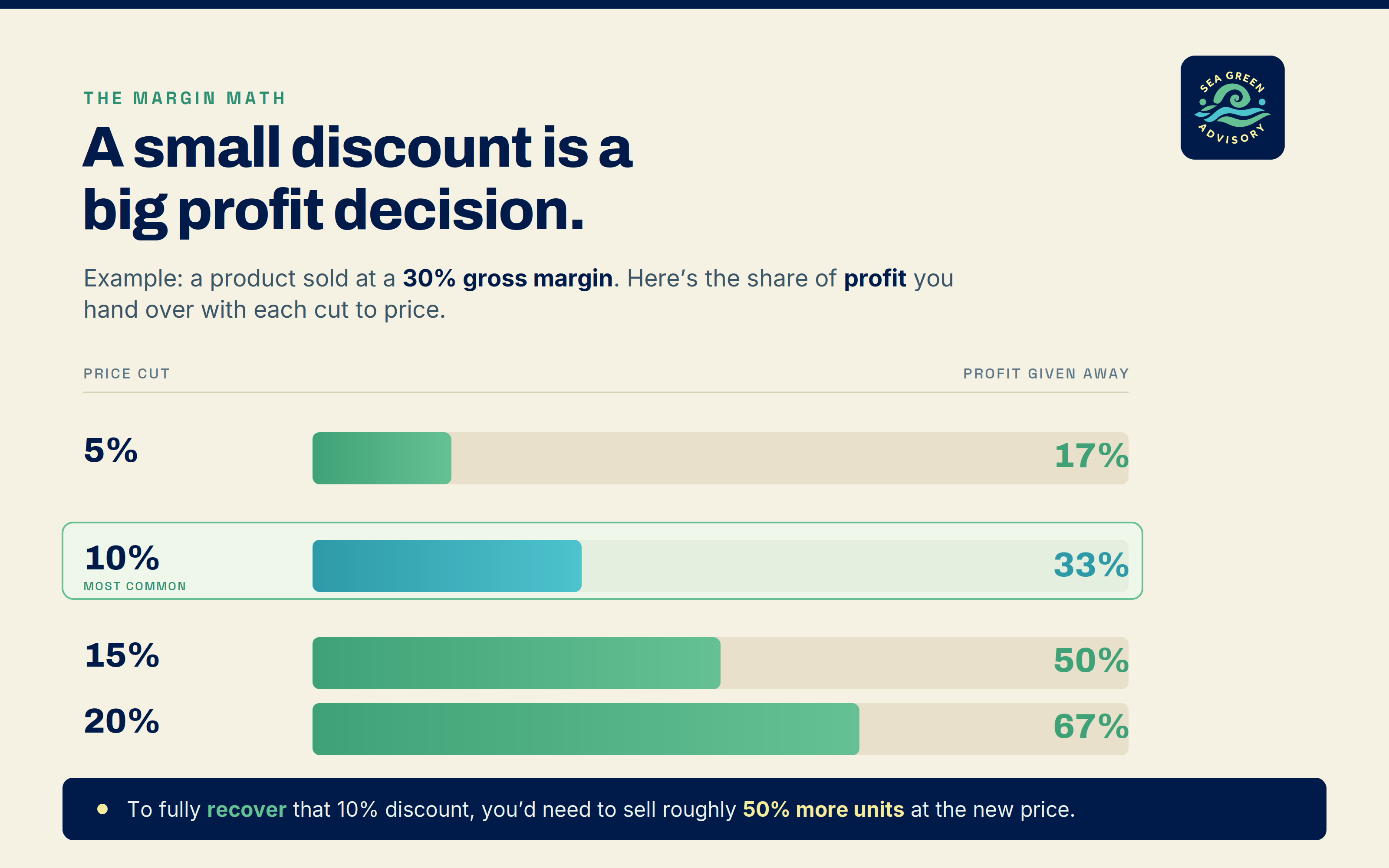
And it gets worse when you think about recovery. To earn back that same total profit at the discounted price, you'd need to sell roughly 50% more units. Fifty percent — for a "small" discount that took ten seconds to give.
A discount is a permanent decision about margin, made in a temporary moment of pressure.
This is the first thing every commercial team should internalise. Small movements on price are large movements on profit — and the person authorising the discount is rarely the person who feels the consequence.
If you only watch the headline discount, you'll miss most of the leak.
In complex industrial deals, margin rarely disappears in one dramatic cut. It seeps out across the life of the deal, one reasonable-sounding concession at a time. The industry even has a name for the gap between the price you list and the margin you actually bank: the pocket-price waterfall.
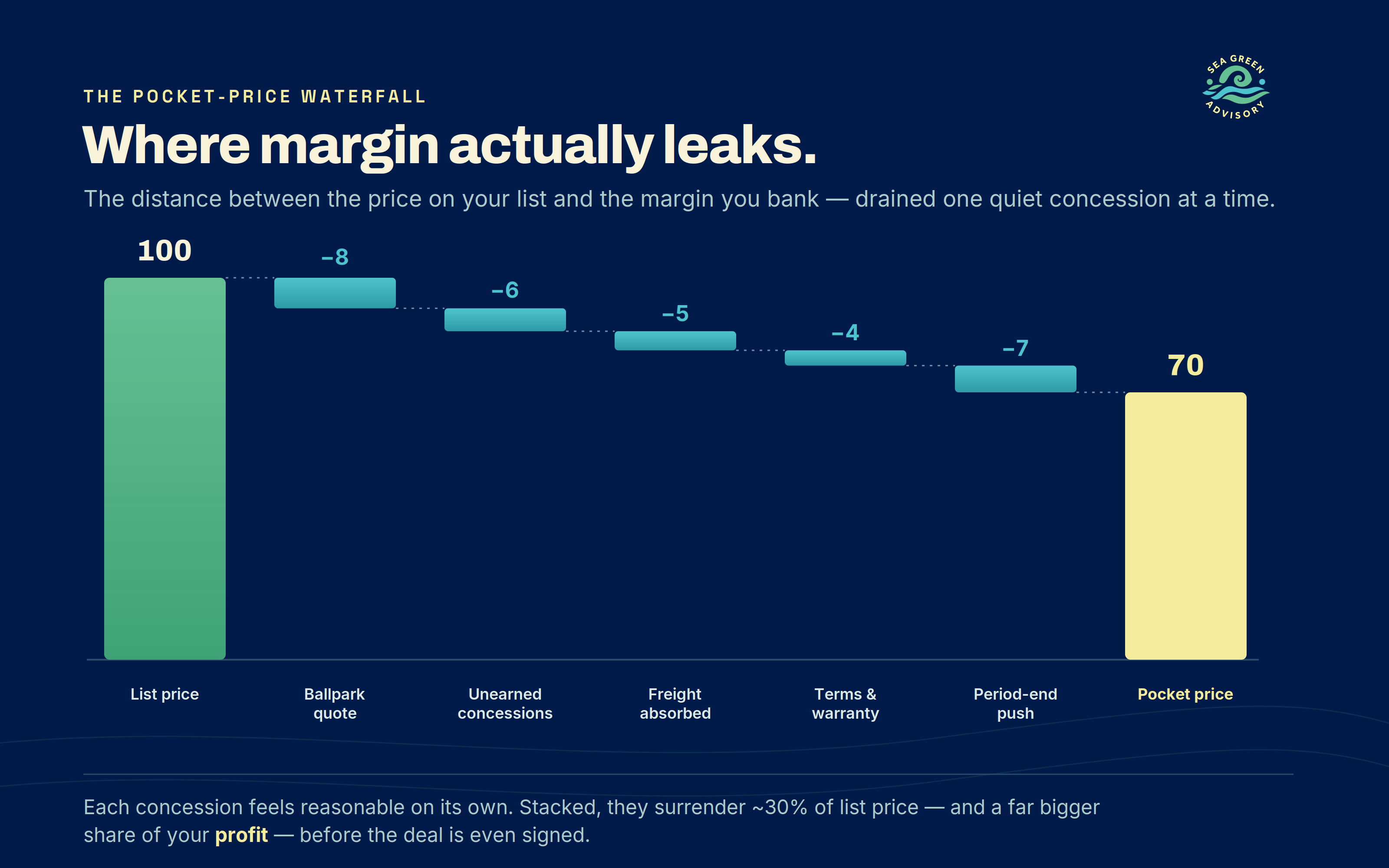
It usually looks something like this.
A ballpark quote too early sets the anchor low before anyone properly understands the requirement. Then come the unearned concessions — a few points given simply because they were asked for. Freight gets absorbed to look sharper. Payment terms stretch, and an extended warranty slips into the deal at no charge. And right at the end, a period-end push shaves a little more off to land the number this month.
None of these feel dramatic. Each one is defensible on its own. But by the time the deal is signed, a "small" 30% of your list price can be gone — and because of the maths above, a much larger share of your profit walks out with it.
The point of naming the waterfall is simple: you can't defend margin you can't see. Most teams manage the one discount they negotiated. The best teams manage all six leaks.
Before the framework, it's worth being honest about the causes. In my experience it's almost never laziness. It's a handful of very human, very fixable patterns.
Notice how many of these have nothing to do with pricing policy. That's why a new price list rarely fixes a discounting culture. You have to change the reflex.
Here's a practical way to do it.
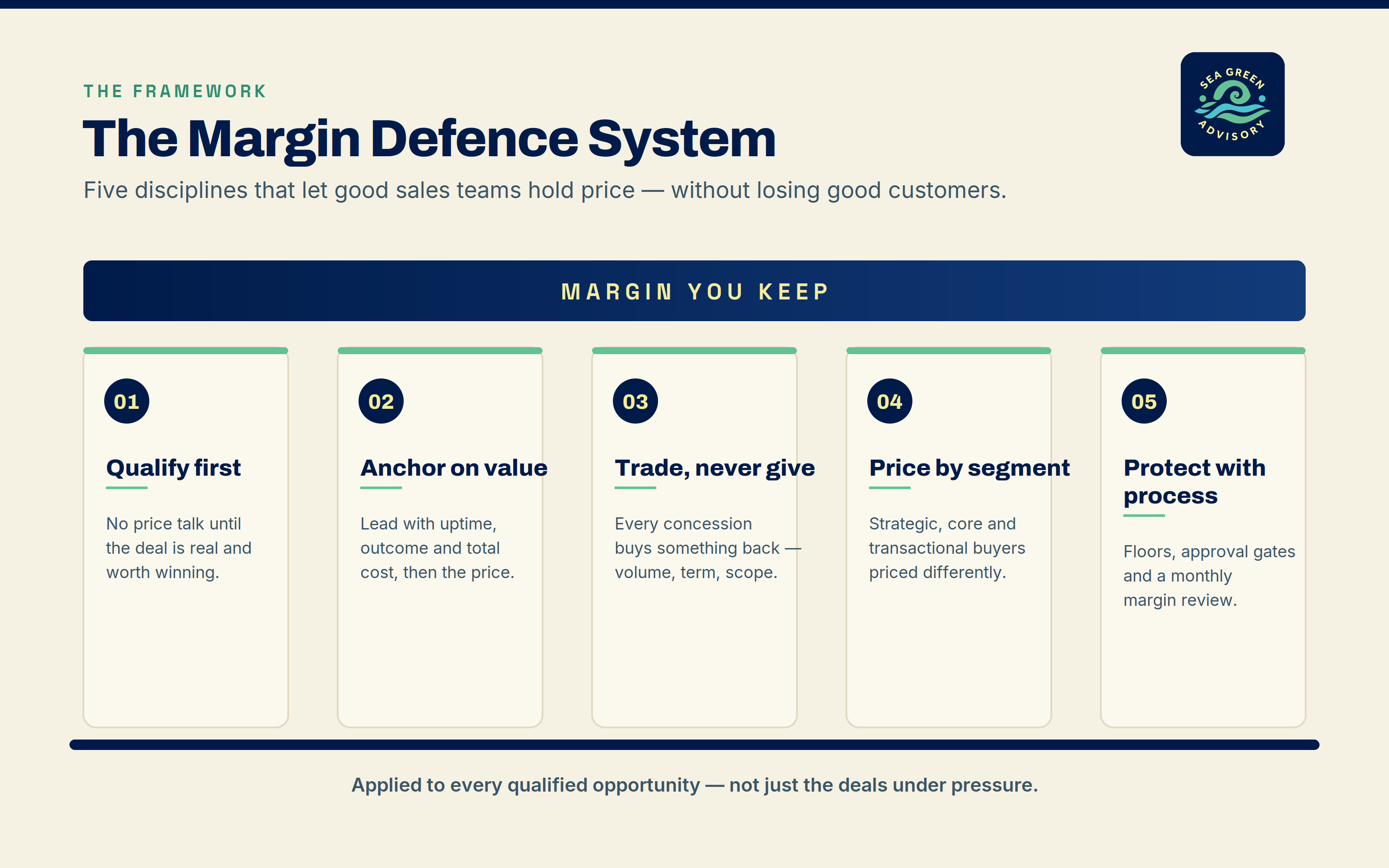
Five disciplines. None of them are complicated. Together they let good teams hold price without turning into the difficult supplier nobody wants to deal with.
The best margin protection happens before price is ever discussed.
A deal that's properly qualified — real problem, real timing, real budget, a real decision-maker — simply needs less discounting, because the customer actually wants the outcome. A deal that isn't qualified is where discounts go to die: you sense the wobble, and you plug it with price.
So the discipline is blunt. No serious price movement on an unqualified deal. If you don't yet know why they'd buy, what happens if they don't, and who signs, you're not ready to talk numbers — and you're certainly not ready to cut them.
By the time a customer is staring at your number, the framing is already set. The real work happens earlier.
Before the price lands, the customer should be able to describe — in their own words — what they're getting beyond the product: the uptime, the parts availability, the service network, the lead-time certainty, the total cost of ownership over the life of the asset.
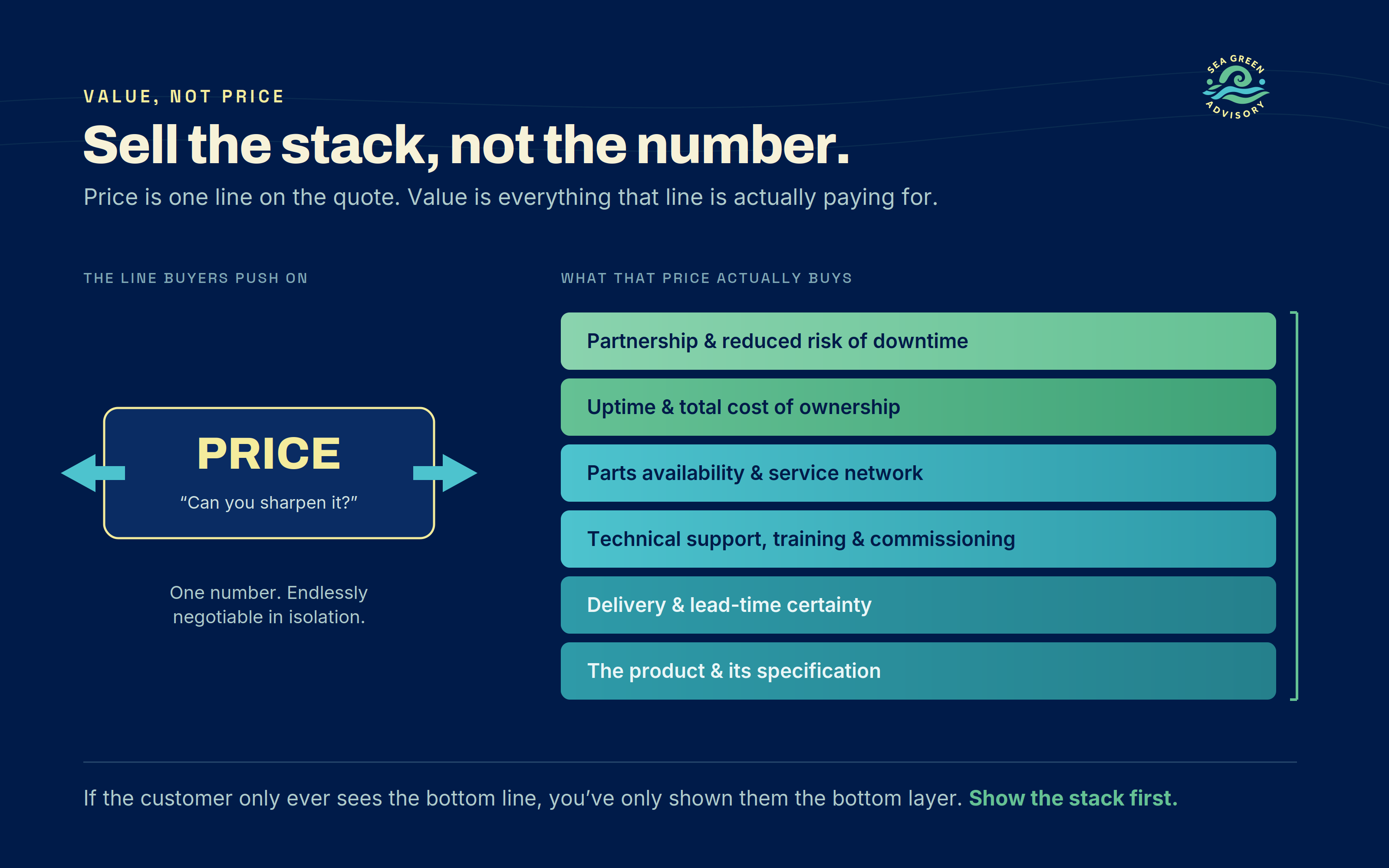
Price is one line on a quote. Value is the entire stack that line is paying for. If the only thing you've put in front of the customer is the bottom line, don't be surprised when the bottom line is the only thing they push on. Show the stack first, and the number has somewhere to sit.
This is the discipline that changes behaviour fastest, and it's almost embarrassingly simple.
Every concession must buy something back.
If a customer wants a better price, that's a negotiation — not a favour. So what comes back the other way? More volume. A longer term. A wider scope. A service agreement. A reference site. A commitment to standardise. Faster payment.
The moment you give a concession for nothing, you've taught the customer two things: that your first price wasn't real, and that pushing works. Both guarantee more pressure next time.
"I can look at the price — if we can talk about volume across the fleet" is a completely different conversation to "sure, I'll take five percent off." Same discount. Completely different signal.
Not every customer should be handled with the same pricing logic — and treating them as if they should is exactly how margin gets averaged away.
This connects directly to account segmentation. A strategic account you're deliberately investing in to grow is a different pricing conversation to a transactional buyer who's price-driven by nature. The mistake isn't discounting; it's applying one blanket rule — usually the most generous one — to everybody.
Strategic customers should receive more value, not automatically the lowest price. Transactional buyers should be served efficiently through simpler channels rather than bespoke deals. Segment your pricing the way you segment your accounts, or you'll end up handing your best terms to the customers least likely to reward them.
Individual willpower doesn't hold margin. Process does.
That means a few unglamorous things: clear discount floors that can't be crossed without approval, an approval gate that's actually enforced, visibility of realised margin (not just list-versus-invoice), and a monthly review where the team looks at where price moved and why.
The goal isn't bureaucracy or slowing deals down. It's making the held price the path of least resistance — and the discount the thing that requires a reason. In a lot of businesses right now, it's the other way around.
Frameworks are easy to nod along to and hard to use at 4:45pm on the last day of the month. So here's the version that fits on a sticky note.
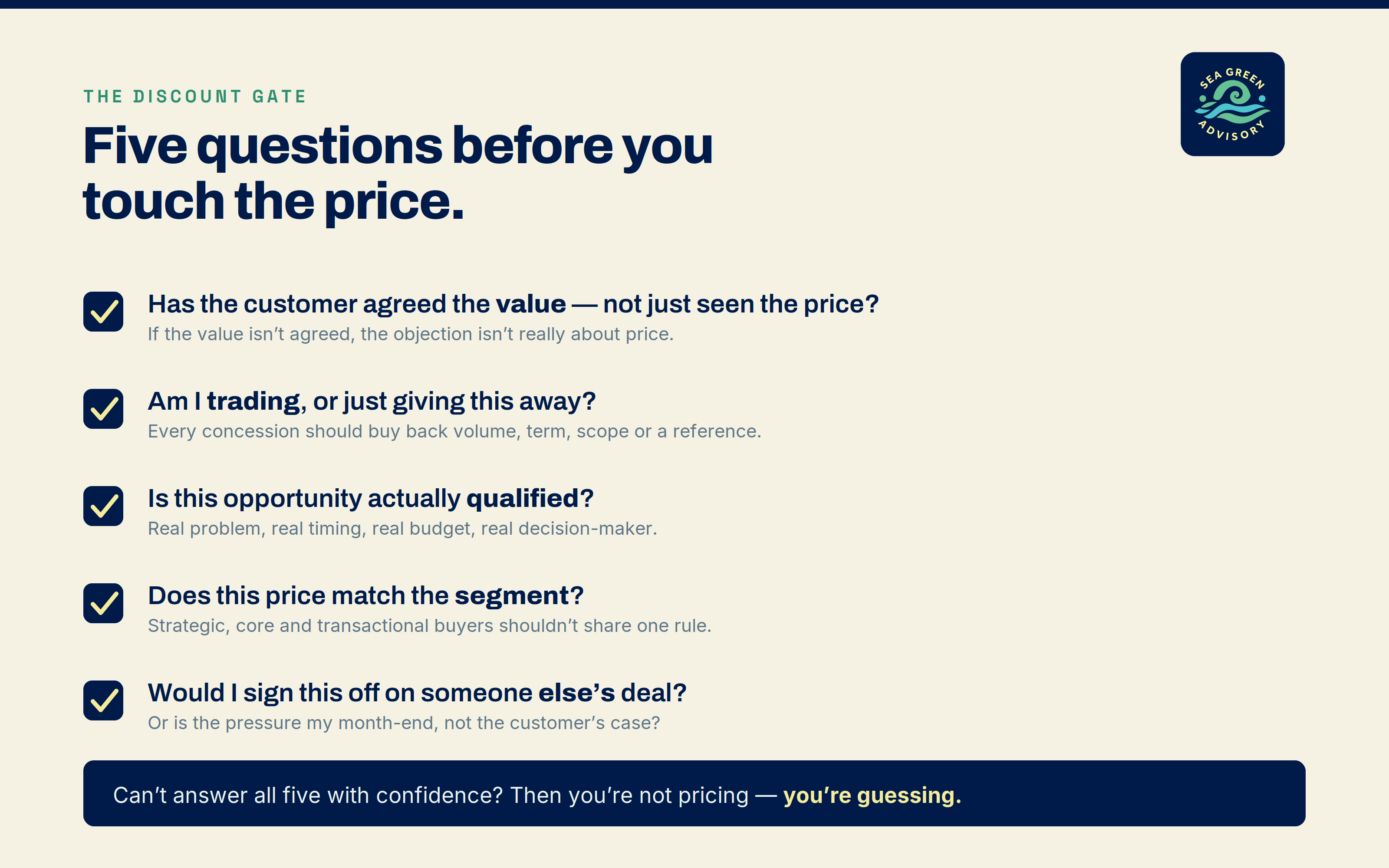
Before you touch the price, run the deal through five questions:
If you can't answer all five with confidence, you're not pricing. You're guessing.
One more practical note, because this is where good intentions tend to fall over.
Holding price is a conversation, and most teams simply don't have the words ready. When "your price is too high"lands, the instinct is either to defend the number or to fold. There's a better third option: get curious.
"Too high compared to what?" is a fair, friendly question — and the answer tells you almost everything. Sometimes it's a genuine competitor. Often it's a budget number someone invented, a comparison against a lesser spec, or simply an opening move. You can't respond well to an objection you haven't understood.
From there, the move is to bring the conversation back up the value stack rather than down the price line: "Let's make sure we're comparing the same thing — including the parts availability and the uptime, because that's usually where the real cost lives." You're not refusing to talk price. You're refusing to talk about price in isolation.
And if a discount is genuinely warranted? Give it deliberately, trade for it, and make it visible — not reflexively, in the quiet panic of a deal going cold.
Here's the part that isn't the salesperson's fault.
Sales teams discount the way they're led to discount. If leadership celebrates closed deals, forecasts and volume — and never asks about realised margin — then margin is exactly what the team will spend to hit the visible numbers.
If you want a team that holds price, the signals have to change:
Culture beats policy here. You can write any discount matrix you like; the team will still do what gets rewarded.
When a business breaks the discount reflex, the change is quieter than you'd expect. There's no dramatic price rise, no customers storming off.
What you notice instead is that deals hold their shape. Concessions come with something attached. Reps get curious about objections instead of flinching at them. Forecasts get calmer, because the numbers aren't being propped up by end-of-month giveaways. Margin stops leaking in the places nobody was watching.
And crucially — you don't lose the good customers. The ones you were afraid of losing were, in almost every case, buying far more than price. They just needed to be shown the rest of the stack.
Because that's the real lesson underneath all of this. Discounting is rarely a pricing decision. It's a confidence decision, made under pressure, in the absence of a system. Give the team the system — qualification, value, trading, segment-aware pricing, and a bit of process to lean on — and the reflex loses its grip.
The price on your quote is a number. The margin you keep is a choice. Make it deliberately.
Sea Green Advisory works with businesses across commercial vehicles, heavy equipment and industrial markets to build clearer, more disciplined commercial systems.
If your team is winning deals but quietly giving away margin to do it, we can help you build a practical pricing and discounting framework around:
If you'd like to pressure-test how much margin is quietly leaking out of your deals — and what it would take to hold it — connect with Sea Green Advisory.
Book a zero obligation chat to see if we’re a good fit for success. We’re ready any time.
Have a chat